
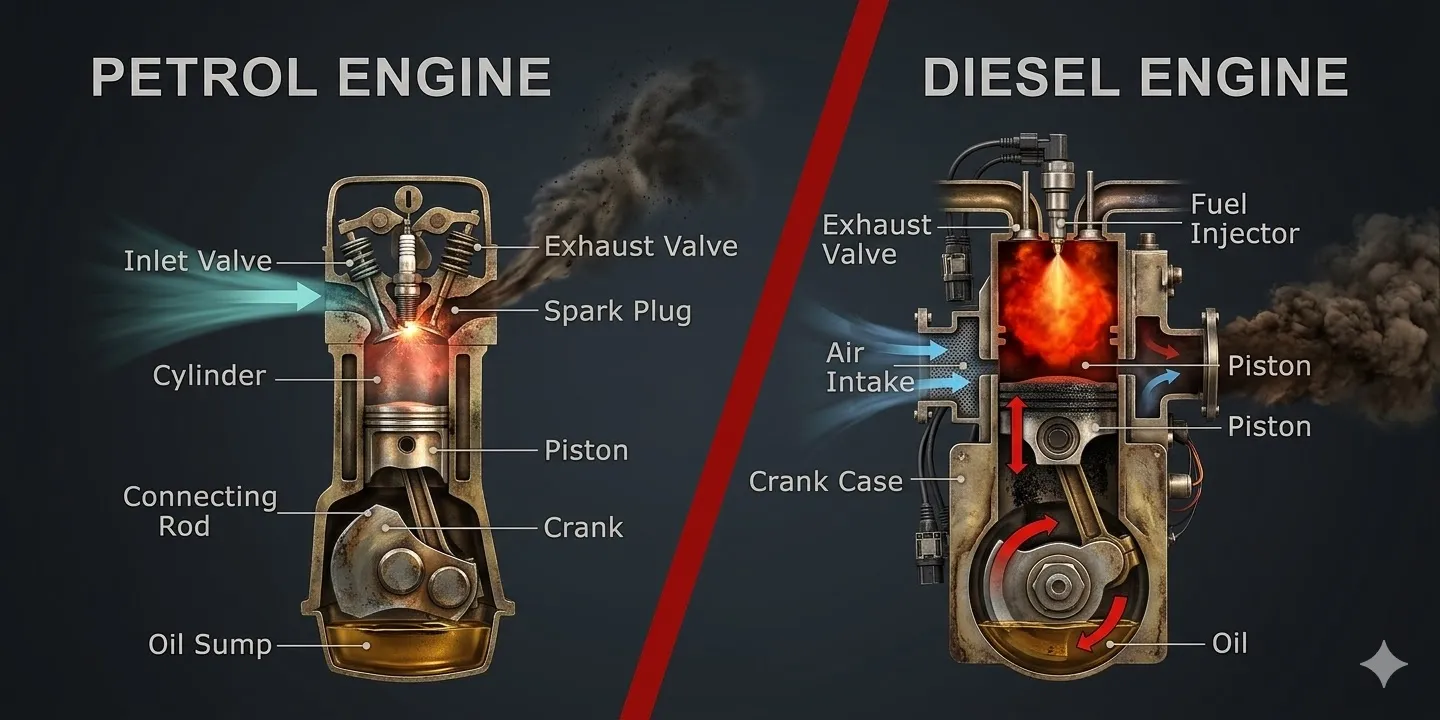
Petrol or diesel? It's one of the oldest arguments in motoring — and there's still no single right answer that works for everyone.
What's interesting is that the tide has been shifting toward petrol for a while now. Think back: when did you last walk into a dealership and see a brand-new diesel on the forecourt? Several European cities have also introduced restrictions on diesel vehicles, and more are likely to follow. But that doesn't mean diesel is dead — far from it. It just means the choice matters more than ever.
So let's break it down properly.
What's the actual difference between a petrol and diesel engine?
The core difference comes down to how the fuel ignites.
In a petrol engine, fuel mixes with air and is ignited by a spark from the spark plug — that's literally what the spark plug is for. The explosion pushes the piston down and turns the engine.
In a diesel engine, there are no spark plugs (there are glow plugs, which are different — they just help with cold starts). Instead, air is compressed so intensely that it gets extremely hot, and when diesel fuel is injected into that hot, compressed air, it ignites on its own. No spark needed.
That difference in how combustion happens is what drives almost everything else — the torque characteristics, the fuel economy, the noise, the maintenance costs, all of it.
Diesel engines — the pros and cons
The good stuff
Diesel engines produce significantly more torque than comparable petrol engines. Torque is the pulling force — the shove you feel when you accelerate from low speed. Diesel delivers that shove early, which is why diesel cars feel effortless at motorway speeds and why diesel is the default choice for anything that needs to tow or carry heavy loads.
They're also traditionally more fuel-efficient. A diesel engine typically produces more usable energy per litre of fuel than a petrol, which translates to better miles per gallon, especially on longer runs and motorway driving.
And when it comes to longevity, diesel engines — when properly maintained — tend to last longer. Some diesel engines have legendary reputations for reliability. Renault/Nissan's 1.5 dCi (K9K) engine, for example, has powered everything from the Megane to the Qashqai, and is widely regarded as one of the most durable diesel units ever built.
The not-so-good stuff
Diesel engines are noisier. The clatter at idle is unmistakable, especially on older engines. And yes, the exhaust smell is different — most people prefer petrol's scent.
They take longer to warm up in cold weather, which means sitting in a cold cabin for longer on winter mornings.
Cold starts can be a proper headache. Diesel engines are less forgiving when components are even slightly off — poor compression, dodgy injectors, degraded glow plugs — and in winter, those issues come to the surface fast. A petrol engine will often limp along even when it's not in perfect health. A diesel will simply refuse to start.
As Alexander, a workshop manager at TAEX automotive, puts it: "If the pressure in the cylinders is below normal, or the injectors aren't firing correctly, you'll find out about it in winter. A petrol engine doesn't care as much — it'll usually still start. A diesel won't."
The fuel system on a diesel is also significantly more complex than on a petrol engine. High-pressure injectors, common rail systems, DPF filters, EGR valves — all of it is more expensive to repair when something goes wrong. Whatever you save on fuel, it's worth keeping some of it back for the day the fuel system needs attention.
Petrol engines — the pros and cons
The good stuff
Petrol engines are quieter and smoother. If you're in a premium or luxury car, a petrol engine just feels more refined — and sounds better too.
They warm up faster in winter, which means you're not freezing for the first ten minutes of every commute.
Petrol engines are generally simpler, cheaper to service, and cheaper to repair when something does go wrong. No DPF to worry about, no AdBlue system, fewer expensive components in the fuel circuit.
And if you're open to it, petrol engines work well with LPG (liquefied petroleum gas) conversions. Running on LPG costs significantly less per mile than petrol, and a decent conversion pays for itself relatively quickly if you cover decent mileage.
The not-so-good stuff
Petrol engines typically use more fuel than comparable diesel engines — that's just the reality, especially on motorway runs. The gap has narrowed with modern direct injection systems, but it's still there.
Lower torque than diesel is the other main downside. For everyday town driving it makes no difference, but if you're towing, loaded up, or overtaking regularly at motorway speeds, you'll notice it.
So which one should you actually buy?
It depends entirely on how you use your car. There's no universal winner here — only the right choice for your situation.
Go diesel if:
- You do a lot of motorway miles
- You tow regularly or carry heavy loads
- High mileage is your main concern (diesels tend to last longer under hard use)
- You drive a commercial vehicle for work
Go petrol if:
- Most of your driving is urban or short commutes
- You want lower servicing costs and simpler repairs
- You want a premium or luxury car (quieter, more refined)
- You want easy cold starts and no winter drama
- You're considering an LPG conversion
Is it true that petrol engines like high revs, and diesels prefer low revs?
Yes — and it comes down to where each engine produces its best torque.
In a petrol engine, combustion is triggered by a spark at a precise moment. The torque 'peak' — the point where the engine pulls hardest — typically arrives between 3,500 and 4,200 RPM. Below that, a petrol engine can feel a bit flat. You need to rev it to get the best out of it.
A diesel works completely differently. Fuel ignites from the heat of compression alone, and that happens very early in the rev range. A diesel engine often makes its full torque from as low as 1,500–2,000 RPM. That 1.6-litre diesel in a French hatchback feels deceptively quick off the line because it's already making all its torque before you've touched 2,000 RPM.
Revving a diesel hard isn't going to unlock extra performance — there isn't much more to find up there, and it puts unnecessary stress on the engine. Rev a petrol, though, and you'll find it comes alive.
Conclusion — Making the right call for your car
Both engines have their place in 2026. Diesel still makes sense for drivers who cover high mileage, tow regularly, or rely on their vehicle commercially. Petrol makes more sense for urban drivers, short-run commuters, and anyone who wants simpler, cheaper ownership with no cold-start stress.
One thing worth mentioning: whichever engine you choose, the way it's tuned from the factory isn't necessarily the best it can be. At BSG Automotive, we remap both petrol and diesel engines — improving throttle response, mid-range performance, and in many cases, fuel economy. A well-done Stage 1 remap gets the best out of whichever engine you've got.
Got questions about your engine, or want to know what a remap could do for your specific car? Drop us a message — we'll give you a straight answer.
Want to get the most out of your petrol or diesel engine? See full details on our Stage 1 ECU Remap Service page.