These are the questions we hear from BMW diesel owners before they book a remap. We've answered them plainly — no sales spin, just accurate information so you know exactly what you're getting into.
These answers cover both the N47 (2.0-litre 4-cylinder) and the N57 (3.0-litre 6-cylinder). Where there's a meaningful difference between the two engines, we've noted it.
Frequently Asked Questions
If your BMW is still within the manufacturer's warranty period, yes — a remap will affect your cover. BMW dealers run ECU diagnostics when assessing warranty claims on the engine or drivetrain. If the ECU shows evidence of modification and you're making a claim for something related to the powertrain, the dealer can decline it.
That said, the vast majority of BMW diesels being remapped in the UK are outside their original manufacturer warranty. Most are 5–12 years old. If yours is out of warranty, this is simply not a concern.
If you have a third-party extended warranty, the terms vary. Some exclude modified vehicles outright. Others only exclude claims directly caused by the modification. Check the wording of your specific policy before going ahead.
A correctly calibrated Stage 1 remap typically improves fuel economy at steady motorway speeds. The engine makes more torque, which means it achieves the same road speed at a lower throttle opening. Less throttle = less fuel consumed per mile.
In town and mixed driving, the result depends on how you use the extra performance. If you drive the same way you always have, fuel economy stays broadly the same or improves slightly. If you use the extra torque aggressively, you'll use more fuel.
On the N47 and N57 specifically, the mid-range torque gains mean you'll spend less time holding gears down on motorway overtakes. That translates directly to better economy for drivers who cover significant motorway mileage.
It can be — but a thorough pre-tune diagnostic is non-negotiable. Mileage alone doesn't disqualify a car from being remapped. What matters is the mechanical condition of the engine at the time of the remap.
On the N47, timing chain condition is the critical check. The N47 has a known history of timing chain stretch on higher-mileage examples. We will not remap an N47 that shows signs of timing chain wear or fault codes related to cam/crank timing. Putting more load through an engine with a compromised timing chain is not something we do.
On the N57, turbocharger condition and boost actuator function need to be checked. The N57's twin-turbo system is generally more robust than the N47's single turbo, but a worn VNT mechanism or sticking wastegate will prevent the engine from hitting the boost targets in the remap properly.
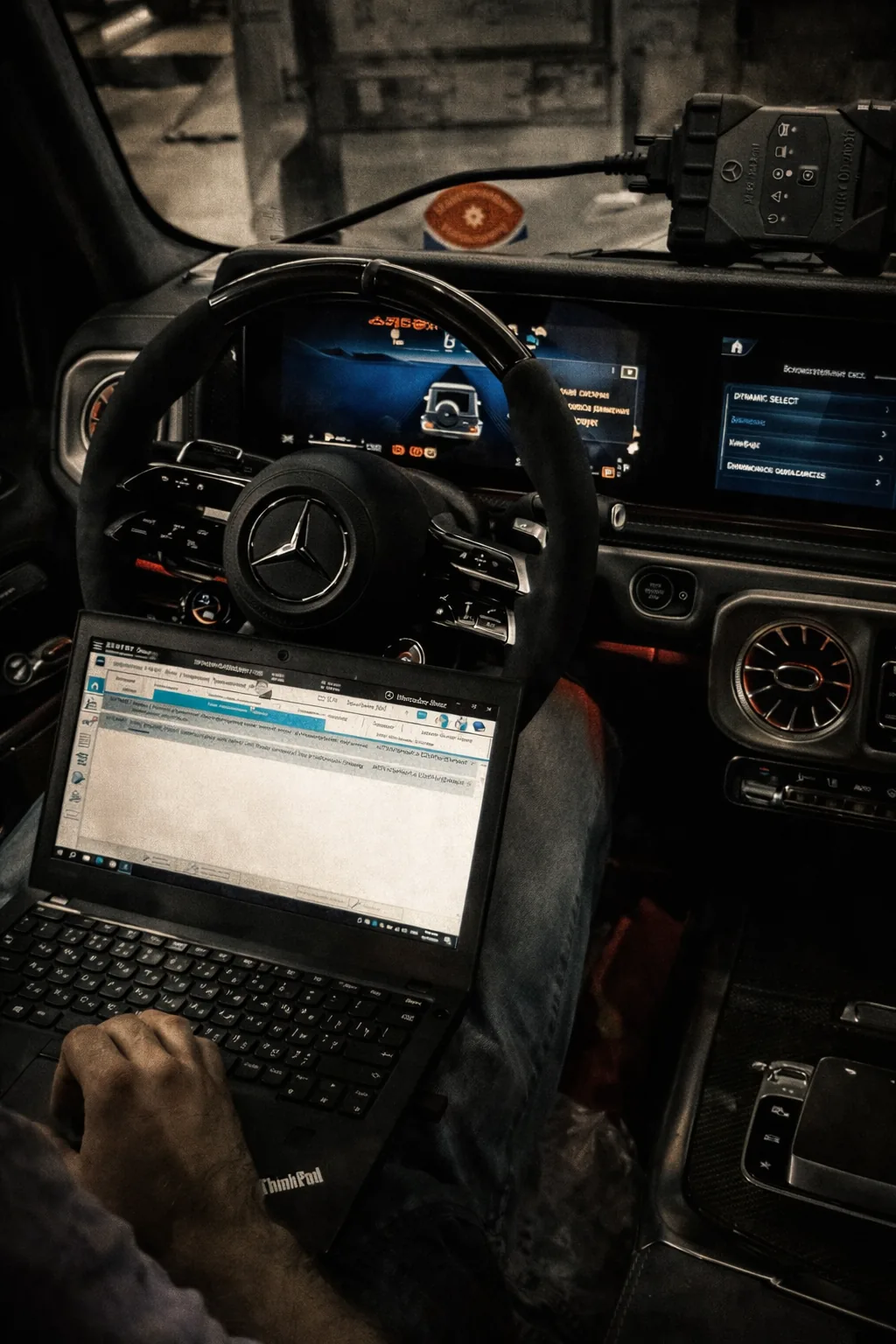
We carry out a full OBD diagnostic scan before every remap. If the car isn't in a fit state to tune, we'll tell you — and we won't remap it until it is.
Yes. Before we write any modified file to your ECU, we read and save the original factory calibration. That file is retained.
If you want to return to stock — for a dealer service, for an MOT emissions test, or because you're selling the car — we can reflash the ECU back to the original calibration. The process takes the same time as the remap itself.
There is no physical hardware to remove because a remap is purely a software change to the ECU. Nothing has been cut, spliced, or added under the bonnet.
For a Stage 1 remap, allow 1.5 to 2.5 hours total. That includes:
- Pre-tune OBD diagnostic scan and live data review
- Baseline data logging of stock boost and fuelling
- ECU read and file preparation
- Flashing the modified file to the ECU
- Post-tune data log to verify boost and fuelling targets
- Road test
More involved work — gearbox mapping alongside the engine remap, a custom Stage 2 build, or multiple modules — takes longer. We'll give you a time estimate when you book.
Stage 1 is a software-only remap on a standard, unmodified car. It works within the limits of the stock turbo, injectors, fuel pump, and intercooler. No hardware changes are needed. This is the right starting point for almost all BMW diesel owners and produces a meaningful improvement in power and torque without touching the physical engine.
Stage 2 involves hardware upgrades before or alongside the remap — typically a larger intercooler, uprated fuel injectors, or a hybrid turbocharger. The ECU file is then written specifically around that hardware. Stage 2 is relevant if you want performance beyond what the stock platform can safely deliver, or if you're building a car specifically for performance use.
On the N57, Stage 2 is more common than on the N47 because the 6-cylinder platform handles the additional hardware investment better and has more headroom for development.
This depends on how the remap was carried out and what diagnostic software the dealer uses. BMW ISTA (their dealer diagnostic system) can detect certain ECU modifications depending on the method used to write the file.
Some remapping methods leave a detectable trace; others are harder to identify. If you need the car to appear stock — for warranty purposes or a dealer inspection — the most reliable approach is to have the ECU reflashed back to the original file before taking it to the dealer. We retain the original file for exactly this reason.
If your car is out of warranty and you're just taking it in for a routine service, most dealers are not actively looking for remap evidence and it is unlikely to become an issue.
Turbocharged diesel engines in general respond well to remapping because the factory ECU calibration is deliberately conservative — it's written to satisfy emissions regulations, fuel quality variation across markets, and warranty longevity. There is meaningful headroom left on the table.
On the BMW side, both the N47 (2.0-litre, fitted to the 1 Series, 3 Series, 5 Series, X1 and X3 from 2007–2015) and the N57 (3.0-litre, fitted to the 5 Series, 7 Series, X5 and X6 from 2008 onwards) respond well. The N57 in particular — especially in 530d and 730d specifications — has a strong reputation for Stage 1 results due to the twin-turbo architecture and the relatively conservative factory torque limits on the ZF 8HP gearbox.
The N57 in the 530d (258bhp stock) typically gains around 60–70bhp and 100–120Nm on a correctly calibrated Stage 1. The 730d and X5 30d produce similar gains. The N47 in the 120d (177bhp stock) typically sees around 40–50bhp and 60–90Nm on Stage 1.
The most important thing is to make sure your car is in good mechanical condition. A remap does not fix underlying problems — it adds load to the engine. An engine with faults will behave worse after a remap, not better.
Specifically, before bringing any BMW diesel in, it's worth:
- Checking whether any fault codes or warning lights are present
- Making sure the car is up to date on servicing — fresh oil and a new fuel filter matter more on a diesel than most people realise
- On the N47: if you've heard any rattling from the engine on cold start, have the timing chain assessed before booking a remap
- On the N57: if the car has ever had turbo issues or boost-related fault codes, make sure those are resolved first
We carry out a full diagnostic scan before every remap regardless, but arriving with a well-maintained car means we can get straight to work without complications. If we find something during the pre-tune check that makes the car unsuitable for remapping, we'll tell you clearly what needs to be addressed first.
Related guides
If you want more detail on the technical specifics of each engine, we've written dedicated guides for both platforms:
- BMW N47 2.0 Diesel Remap — What We Adjust and Why — boost targets, torque limiters, timing chain advice, and Stage 1 gains by variant
- BMW N57 3.0 Diesel Remap — The 6-Cylinder Difference — twin-turbo system, sequential boost staging, ZF 8HP gearbox limits, and Stage 1 vs Stage 2
BSG Automotive tunes BMW N47 and N57 diesel engines across West and North London. Every remap starts with a full diagnostic scan — if the car isn't ready, we'll say so before we start.
See full details on our ECU Remapping Service page, or contact us to discuss your vehicle.