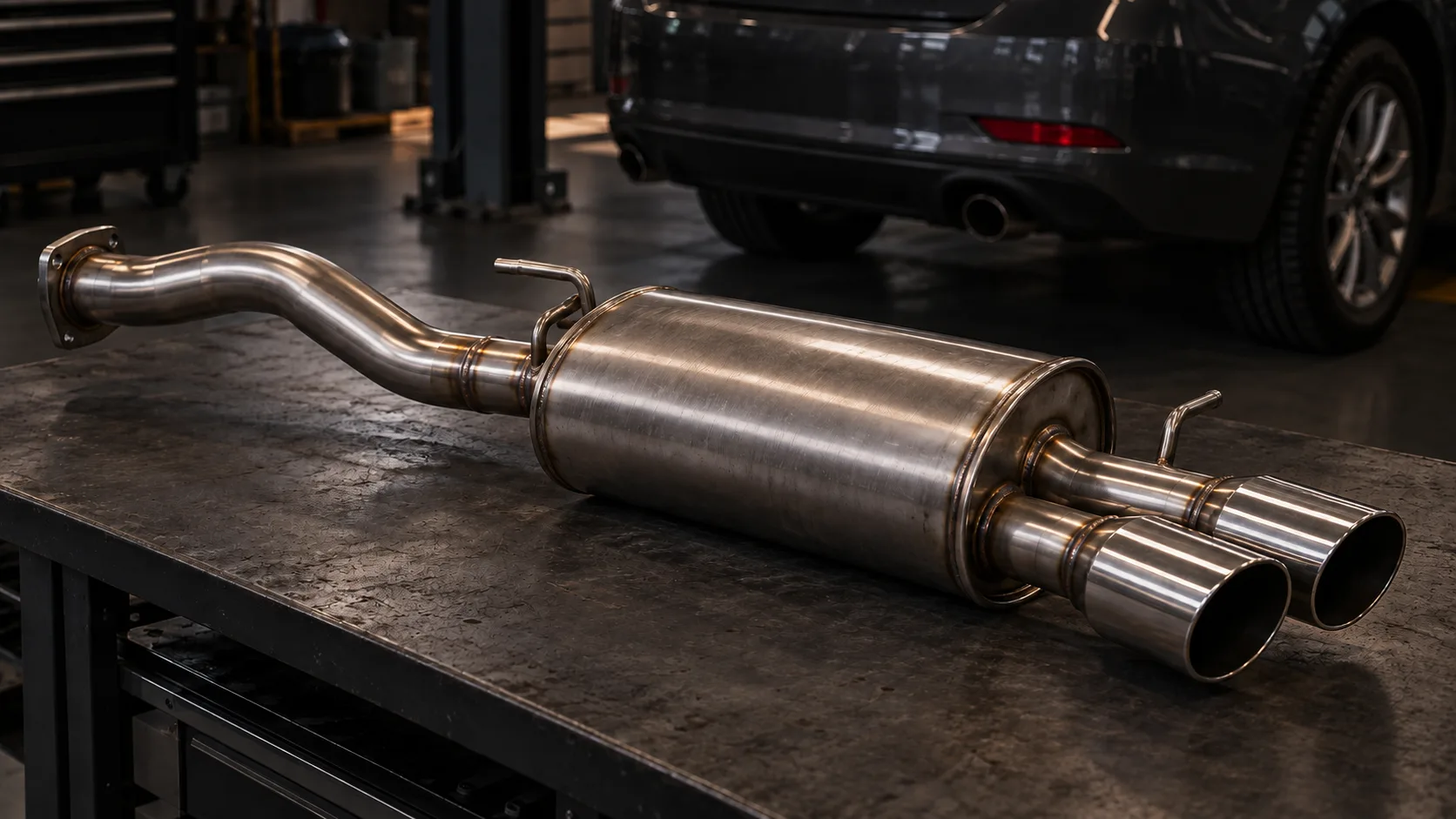
Illustrative image: a generic rear exhaust assembly, not a complete emissions system or a documented BSG customer installation.
Your car’s exhaust system carries combustion gases away from the engine, reduces harmful emissions and controls noise. On a turbocharged engine, those gases also drive the turbocharger. Each section has a different job: a silencer controls sound, a catalyst uses chemical reactions to reduce pollutants and a particulate filter captures particles.
That distinction matters when something fails or you consider an upgrade. A louder exhaust does not automatically produce more power, and replacing a rear silencer is very different from removing emissions equipment. This guide covers modern four-stroke petrol and diesel cars, with UK road use in mind; the exact layout depends on the vehicle.
1. How does a car exhaust system work?
When the exhaust valves open, pressure releases hot combustion gases from the cylinders. The pistons then help push the remaining gases out during the exhaust stroke. These events happen repeatedly, so the exhaust contains pressure pulses rather than a perfectly steady stream.
The manifold collects those gases. On a turbocharged engine, they pass through the turbine, transferring energy to the shaft that drives the intake compressor. Exhaust gas and fresh intake air follow separate paths. The gases then travel through the vehicle’s emissions treatment and sound-control components before leaving the tailpipe. Garrett’s explanation of turbo operation describes this energy transfer.
Two simplified examples show the difference:
- Turbo petrol: engine → manifold → turbine → downpipe → three-way catalyst → petrol particulate filter, where fitted → resonator/silencer → tailpipe.
- Modern turbo diesel with SCR: engine → manifold → turbine → downpipe → oxidation catalyst → diesel particulate filter → AdBlue dosing and SCR catalyst → silencer → tailpipe.
These are functional examples, not fitting diagrams. Components may share a housing, some vehicles have multiple catalysts or dosing points, and the sequence can differ. Naturally aspirated engines have no exhaust-driven turbocharger. Identify the actual equipment before ordering parts.
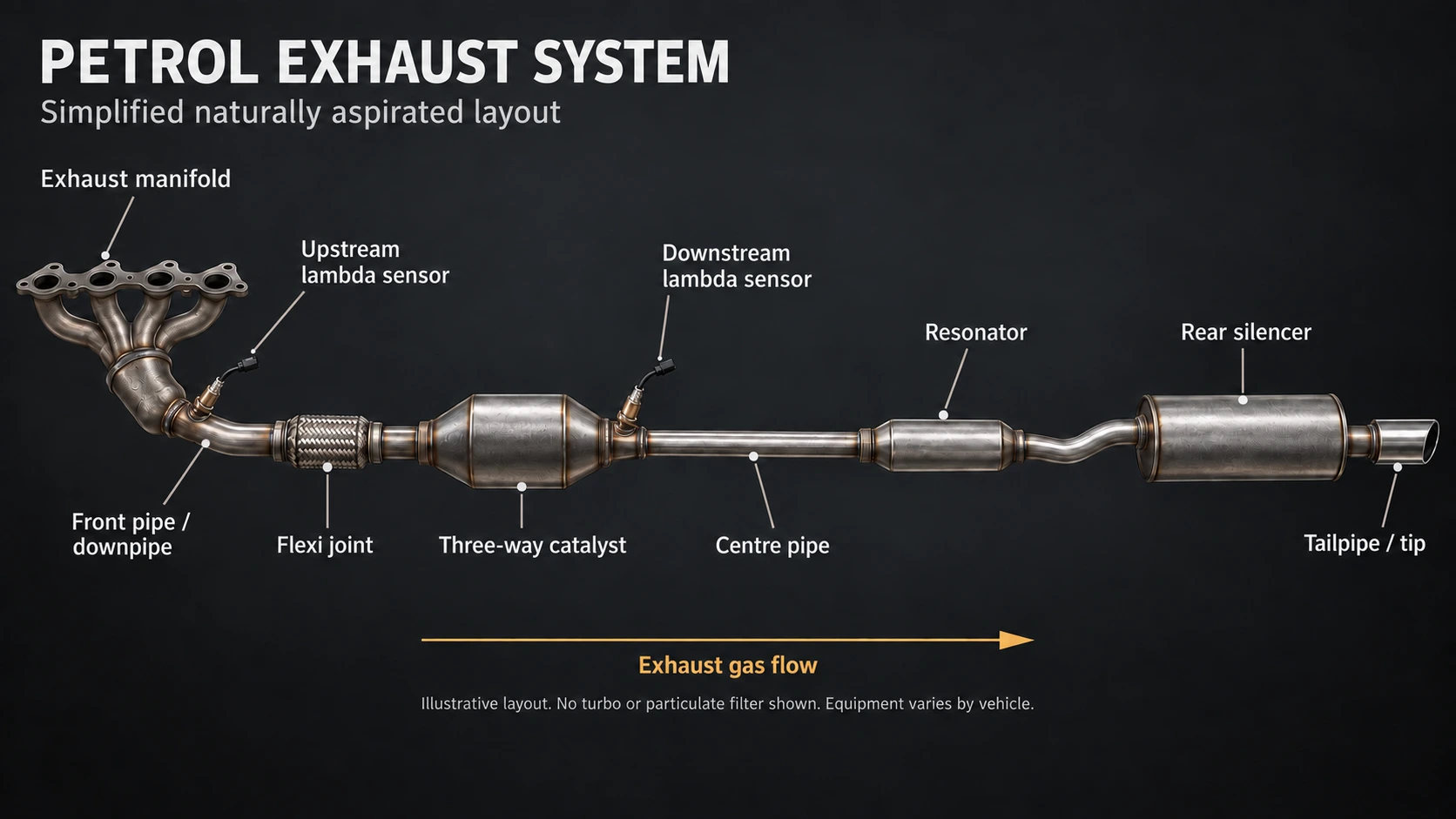
A simplified naturally aspirated petrol layout, read from left to right. No turbo or particulate filter is shown. Mounts and heat shields are omitted for clarity; diesel and newer filtered petrol systems need different layouts.
2. Exhaust components: what each part does
Exhaust manifold and turbocharger
The exhaust manifold joins the cylinder outlets to the next part of the exhaust. It must handle repeated heating and cooling while keeping the joints sealed. Some engines integrate part of this passage into the cylinder head rather than using a separate, obvious manifold.
An aftermarket tubular manifold is often called a header. Its individual pipes and collector influence how exhaust pulses interact. This becomes relevant when discussing engine performance, rather than simply choosing a louder rear section.
The turbocharger turbine extracts exhaust energy. A wastegate, where fitted, controls how much gas bypasses the turbine; other arrangements use variable turbine geometry.
What is a downpipe, and what does it do?
The downpipe is a front section of the exhaust that carries gases towards the rest of the system. On a turbocharged car, it normally starts at the turbine outlet. On some naturally aspirated cars, the pipe leaving the exhaust manifold is also called a downpipe or front pipe. The term is not exclusive to turbo engines: Moss’s classic Mini catalogue uses it for a section starting at the manifold.
In the diagram above, the label points to the curved front pipe between the manifold outlet and the flexi joint. The manifold collects gases from the cylinders; this pipe carries them onwards. It is not a second manifold or a device that creates boost.
A downpipe may be sold as a simple pipe or a larger assembly containing a flexi joint, sensor mounting points and a catalytic converter. On some diesel layouts, the front assembly also incorporates particulate-filter hardware. The boundaries depend on the vehicle and parts supplier, so the word “downpipe” alone does not tell you what is included.
On a turbo engine, the turbine extracts energy as exhaust gas expands across it. Excessive restriction downstream can reduce the pressure difference available across the turbine. This is why the outlet pipe can matter to a tuned engine—but it does not mean every standard downpipe is inadequate. The full exhaust, turbo and engine controls work together. Garrett explains turbine operation.
Fit matters as much as diameter. The correct flange, bends, supports, sensor positions and heat shielding keep the assembly sealed and clear of nearby parts. A leak or poorly aligned joint needs repair, not a software workaround.
Catalytic converters and particulate filters
A catalytic converter provides a coated internal surface where chemical reactions reduce particular pollutants. It needs suitable operating conditions, including temperature. It is not the same device as a silencer, and an ordinary flow-through catalyst is not a soot filter.
A particulate filter captures particles as gases pass through a porous structure. Diesel and petrol filters perform a related task, but their operating strategies differ. The filter’s ability to regenerate does not mean that every blockage or internal fault will resolve through driving.
Resonator, silencer and exhaust valves
A resonator targets particular sound frequencies, helping control harshness or unwanted booming. A silencer, also called a muffler, reduces sound using chambers, perforated passages, absorbent material or a combination of these. The familiar back box is normally a rear silencer.
Different designs can sound very different at the same engine speed. A system that sounds appealing during a brief acceleration may produce tiring cabin drone while cruising. Removing a resonator changes acoustic behaviour; it does not demonstrate that the original part was restricting useful power. Walker explains the different acoustic roles.
Some exhausts include a control valve that changes the available gas path. Depending on the design, it can alter sound or support other operating requirements. An aftermarket controller that holds it open changes the intended behaviour and should not be assumed harmless or compliant.
Sensors and electronic control
The engine control unit (ECU) uses exhaust measurements alongside other engine data. The sensor set varies, but these are common functions:
| Sensor | What it measures | Why the information matters |
|---|---|---|
| Oxygen/lambda sensor | Oxygen in the exhaust | Supports mixture control and, depending on position, catalyst monitoring |
| Exhaust temperature sensor | Temperature at its installation point | Supports thermal protection and aftertreatment control |
| Differential pressure sensor | Pressure difference across a filter | Helps assess restriction and manage regeneration |
| NOx sensor | Nitrogen oxides | Supports emissions monitoring and SCR control |
| Particulate sensor | Particles downstream of a filter | Helps monitor filter performance where fitted |
No single reading proves the whole diagnosis. For example, a pressure reading must be interpreted with exhaust flow, sensor hoses and operating conditions in mind. See Bosch’s differential pressure sensor and SCR control overview.
On a typical petrol system, the upstream lambda sensor helps the ECU adjust fuelling, while a downstream sensor helps monitor catalyst performance. The sensing element turns exhaust oxygen conditions into an electrical signal. This is feedback for the control system, rather than a device that cleans the gases. Bosch explains lambda sensing and placement.
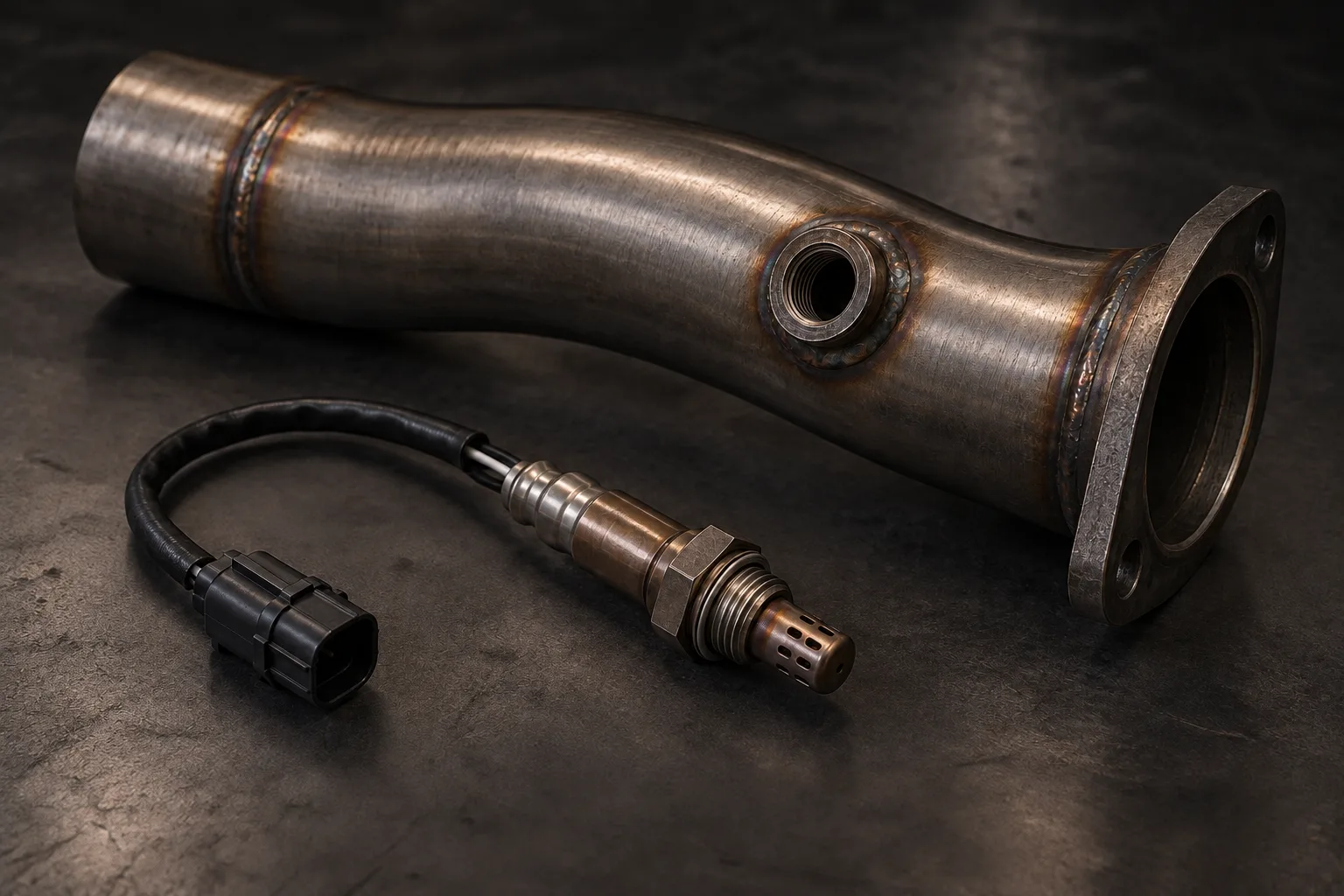
Illustrative component view: the sensor is shown separately from its mounting point.
Flexi joints, mounts, heat shields and tailpipes
The engine moves on its mounts, while the exhaust runs along the body. A flexi joint accommodates relative movement; rubber hangers support the system while limiting vibration transmitted into the car. Flanges, clamps and gaskets keep the separate sections joined and sealed.
Heat shields protect nearby parts and the vehicle floor. They are functional components, not disposable packaging. The tailpipe directs the final discharge outside the vehicle; the decorative tip changes its appearance but does not determine how well the upstream system works.
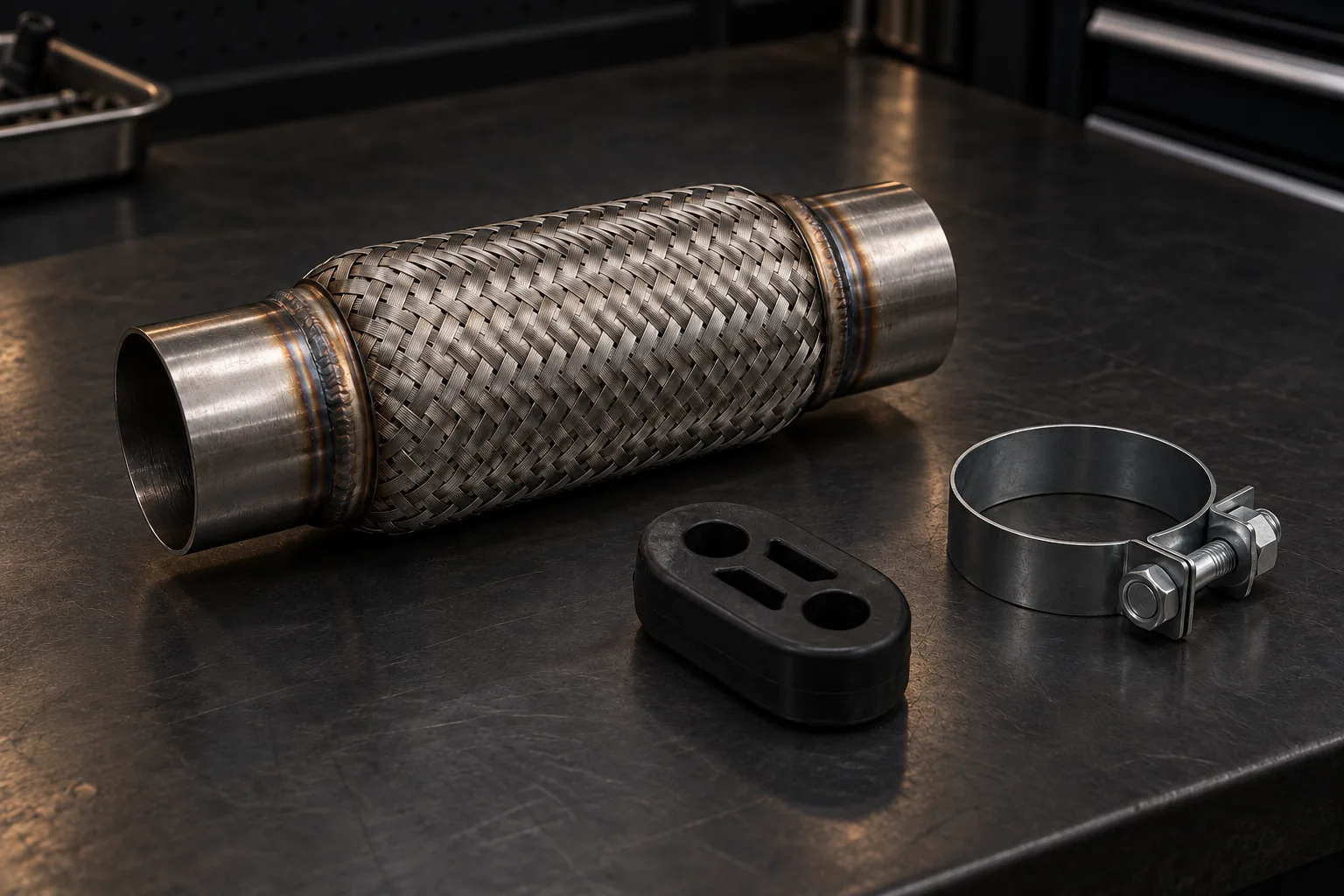
Illustrative component view. The flexible section accommodates movement between parts of the exhaust.
Round and oval pipes, twin exits and quad tips
Pipe shape and the number of visible tips describe different things. Most exhaust tubing is round. An oval pipe section can provide more ground clearance by trading height for width; its dimensions and transitions still need to suit the required flow. Do not assume that an oval section matches a round pipe simply because both carry the same nominal size. Burns Stainless explains the clearance purpose of oval tubing.
Twin exits may be two branches from one main pipe or rear silencer. A true dual system retains two main exhaust paths, typically one from each cylinder bank, although a crossover may connect them. Quad tips mean four visible outlets, not four independent systems. Follow the pipework forwards to understand the layout; counting the tips cannot tell you its flow capacity. Holley discusses single and true-dual systems.
Round, oval, rectangular and slash-cut tips are mainly styling choices. Finish and shape should suit the bumper, with proper heat clearance. Changing the visible tip is a different decision from changing the pipework underneath the car.
3. Petrol versus diesel exhaust systems
Petrol: three-way catalysts and GPFs
Most modern petrol engines use a three-way catalytic converter. Under the appropriate mixture conditions, it reduces carbon monoxide, unburnt hydrocarbons and nitrogen oxides (NOx). Lambda control helps maintain the conditions needed for that process.
The internal channels carry a coating that promotes chemical reactions: carbon monoxide and hydrocarbons are oxidised, while NOx is reduced. The main resulting products are carbon dioxide, water and nitrogen. The catalyst reduces particular pollutants; it does not remove the engine’s carbon dioxide emissions.
Many newer petrol cars also have a gasoline particulate filter (GPF), often called an OPF. It captures particles, particularly relevant to direct-injection engines. Catalyst and filter functions may be combined in one component; not every visible canister represents a separate job. BASF explains combined petrol catalyst and filtration technology.
Petrol filters also need to manage accumulated soot. Do not assume that a GPF can never require attention because petrol exhaust is generally hotter in some operating conditions. Follow the warning and driving instructions for the specific vehicle rather than applying a diesel regeneration routine to it.
Diesel: DOC, DPF and SCR
Diesel engines normally operate with excess air. Their oxygen-rich exhaust requires a different approach to NOx control from the conventional petrol three-way catalyst.
The diesel oxidation catalyst (DOC) oxidises carbon monoxide and hydrocarbons. The diesel particulate filter (DPF) captures soot. During regeneration, suitable conditions allow that soot to oxidise. Non-combustible ash remains, so regeneration and ash removal are different processes. Cleaning or replacement decisions depend on the filter’s condition and the vehicle manufacturer’s guidance. Cummins describes these core aftertreatment functions; its equipment examples should not be treated as passenger-car service schedules.
In a wall-flow filter, alternate channels are closed at opposite ends, forcing gases through porous walls that capture particles. Passive regeneration uses suitable conditions already present in the exhaust; active regeneration deliberately raises exhaust temperature through the engine’s control strategy. Exact methods vary. Neither process burns away the mineral ash that gradually accumulates.
Selective catalytic reduction (SCR) deals with NOx. AdBlue is metered into the exhaust, where it produces ammonia that reacts with NOx over the SCR catalyst to form nitrogen and water. AdBlue belongs in its own tank, not the diesel tank. Some systems also use an ammonia slip catalyst to control ammonia leaving the SCR stage. Bosch’s Denoxtronic overview explains dosing and control.
Not every diesel has SCR or an AdBlue tank. Older designs and alternative NOx-treatment arrangements exist, so fuel type alone cannot identify every component.
Where does EGR fit?
Exhaust gas recirculation (EGR) sends a controlled portion of exhaust back towards the intake. It reduces NOx formation by changing combustion conditions, including lowering peak combustion temperature. It is a recirculation branch, not simply another box between the engine and tailpipe. EGR is used on petrol engines as well as diesels. BorgWarner explains the principle.
| Feature | Typical modern petrol car | Typical modern diesel car |
|---|---|---|
| Main gaseous-emissions treatment | Three-way catalyst | DOC plus NOx control, often SCR |
| Particle control | GPF/OPF where fitted | DPF where fitted |
| AdBlue | Normally absent | Present on SCR-equipped vehicles |
| Regeneration | Vehicle-specific GPF strategy | Vehicle-specific passive/active DPF strategy |
| Modification checks | Catalyst, GPF, lambda control and noise | DOC, DPF, SCR, sensors, regeneration and noise |
The practical difference is what must remain functional. A rear exhaust upgrade on a diesel does not replace the jobs of its DPF or SCR system.
4. Exhaust modifications: what they change and what they give you
The following covers the main categories, including specialist options. Product names are not a complete specification: confirm the exact parts replaced, sensors retained and emissions equipment affected.
Tailpipe tips, axle-back and cat-back systems
Tailpipe tips primarily change appearance. Shape, finish and clearance matter; a larger decorative outlet alone is not evidence of greater engine output.
An axle-back normally replaces the rear section, including the silencer and tailpipe. A cat-back extends forwards to the outlet of the catalytic converter. They can change tone, construction and mass; the performance effect depends on the original restriction and replacement design. Borla defines the two configurations; its US road-legality statements do not establish UK approval.
On a filtered car, check whether a product is actually GPF-back, OPF-back or DPF-back. Marketing shorthand must not conceal removal of a filter or other treatment equipment. A rear-system purchase should be judged on fit, noise, durability and measured evidence, not assumed horsepower.
Resonator changes, silencer changes and valves
Replacing a resonator with another design can target an unwanted tone. Removing it may introduce rasp or drone. A different silencer can change both overall volume and sound character; deleting one usually trades noise control for a simpler gas path.
Valved systems provide different paths or silencing states. Cut-outs open an alternative outlet that bypasses part of the system. The consequences depend on where the bypass is located: it may bypass silencing, emissions treatment or both. A quiet selectable mode does not establish that every operating mode is road-legal.
Active sound generators use speakers or actuators to create sound. They do not increase exhaust flow or engine power. They are a different product from a mechanical exhaust upgrade, even when sold to make a diesel sound more like a petrol performance car.
Larger pipes, mandrel bends and crossover sections
Larger-diameter pipework can reduce restriction where the existing system is undersized. Mandrel bending supports the tube internally to help preserve its cross-section around a bend. Press or compression bending can flatten or narrow that section. The practical question is whether the finished pipe restricts the required flow; a bend type alone does not prove a power gain. Holley’s fabrication guidance explains the distinction.
On suitable twin-pipe layouts, an H-pipe connects the two paths through a balance tube; an X-pipe brings them together through a crossover. These change pulse interaction and sound. A Y-pipe merges or splits a path. The engine, pipe dimensions and placement determine the result; there is no universal best shape. Holley’s exhaust technical guidance discusses sizing and crossover choices.
Performance manifolds and headers
Headers alter the individual cylinder paths and their collector. Correctly matched dimensions can use pressure-wave behaviour to help clear exhaust from the cylinders, known as scavenging, over the intended engine-speed range. A design aimed at high-rpm output may not suit a daily driver’s priorities.
This is particularly relevant to naturally aspirated petrol tuning. On a turbo engine, the manifold must also suit the turbine and pulse arrangement. Packaging, heat management and catalyst positioning need checking alongside any performance claim.
Downpipes, sports catalysts and complete systems
A less restrictive downpipe can matter on a turbocharged engine when the original section limits flow. However, changing turbine outlet conditions can affect boost control. Hardware compatibility, sensor placement, temperatures and calibration need assessment together. Garrett’s system-optimisation guidance supports evaluating the whole turbo system rather than one component.
Unlike a cat-back, which changes the system behind the catalyst, a downpipe upgrade affects the front of the exhaust and may replace emissions hardware. Potential changes include sound, exhaust restriction and turbo response; none is a guaranteed power increase. Ask whether the proposed part retains the original catalyst, replaces it with an appropriately approved unit, or removes it. A “catted” label alone does not establish road suitability.
A sports or high-flow catalyst still has to perform emissions conversion. A catalyst being present, or having a particular cell-density description, does not prove adequate conversion or UK road suitability. Ask for evidence applicable to the exact vehicle and part.
DfT guidance requires a type-approved replacement catalyst for vehicles registered on or after 1 March 2001. Check the part’s applicable approval rather than relying on a seller’s “MOT-friendly” description. Official replacement-catalyst guidance.
Turbo-back, header-back and full-system packages replace a wider portion of the exhaust. They are not universal stage definitions. Check whether the package retains, replaces or removes each catalyst and filter before comparing prices or results.
Materials, heat control and custom fabrication
Stainless steel upgrades may prioritise corrosion resistance. Titanium may prioritise lower mass, while more specialist alloys address particular temperature and strength requirements. Material alone does not establish power, lifespan or fit quality; grade, wall thickness, welds and supports matter.
Ceramic coatings, heat shields and exhaust wrap manage heat transfer. They do not all work in the same way, and wrap should not be added indiscriminately. Check compatibility with the underlying material and the component maker’s instructions. Zircotec’s guidance discusses coating and wrap limitations; its product-specific temperature claims are not universal exhaust gains.
Custom routing, single-to-dual conversions and side exits can change packaging, appearance and sound. They also require careful clearance, support and discharge positioning. More outlets do not automatically mean more power. Reinforced mounts may reduce movement but can transmit more vibration into the cabin.
Straight pipes and emissions deletes
“Straight pipe” is imprecise: it may describe a silencer delete, or a system stripped of catalysts and filters. Ask exactly what is being removed.
A decat removes catalytic treatment. DPF/GPF removal removes particle filtration. SCR/AdBlue defeat disables NOx treatment, while EGR defeat changes the engine’s NOx-control strategy. These are different interventions with different pollutant consequences. Removing a blocked component can hide the symptom without correcting the cause of the blockage.
Software suppression of a warning does not restore the missing function. For a UK road car, pursue diagnosis and a compliant repair rather than treating deletion as the normal upgrade route. The road-use and MOT implications are explained below.
Pops-and-bangs maps, anti-lag and external wastegate outlets
Pops-and-bangs calibrations deliberately change overrun behaviour to produce exhaust noise, often through fuelling and ignition changes on petrol engines. They should not be confused with additional useful power. Excess fuel burning in the exhaust can create damaging heat; Walker describes the catalyst-overheating mechanism.
Anti-lag aims to keep the turbine spinning when the throttle closes. Depending on the strategy, additional airflow, fuelling and retarded ignition maintain exhaust energy, with substantial thermal demands. A crackling exhaust note does not demonstrate effective anti-lag. Haltech’s documentation includes time and temperature limits to reduce the risk of damage; its example settings are not universal safe limits.
An external wastegate can discharge through a separate outlet, sometimes called a screamer pipe, instead of returning gas to the main exhaust. That can bypass silencing and downstream treatment. These specialist arrangements require engineering and event-rule checks; a motorsport label does not authorise public-road use.
5. Will an exhaust upgrade improve power or fuel economy?
An upgrade can help where it removes a meaningful restriction and the rest of the engine can use the change. If the standard exhaust already supports the engine’s output, a replacement may mainly change sound, appearance or weight.
The familiar claim that an engine “needs backpressure” confuses resistance with useful pressure-wave behaviour. Unnecessary restriction is undesirable, but an oversized or poorly matched exhaust can also compromise the intended operating range. The aim is a suitable system, not the biggest pipe available.
Ask for comparable before-and-after measurements on the relevant engine and configuration. They should identify fuel, calibration, test conditions and whether the output is measured at the wheels or engine. Do not compare wheel power with an advertised engine figure or use a universal drivetrain-loss percentage.
There is no defensible universal horsepower or fuel-saving figure for “a performance exhaust”. Fuel consumption also depends on driving behaviour and load. A stronger sound or different throttle feel is not a fuel-economy measurement.
How does an exhaust upgrade work with ECU remapping?
Hardware changes the physical gas path; ECU remapping changes how the ECU controls the engine. A rear exhaust that leaves the original controls and emissions equipment working may need no calibration change. A downpipe or wider engine build needs assessment of boost control, fuelling and operating temperatures together.
Do not buy a package purely because it is called “Stage 1” or “Stage 2”: those labels do not define a universal hardware specification. Ask exactly what changes and what evidence supports the result. A remap should not be used to hide a leak, a failed sensor or a blocked filter.
6. What should you check before replacing anything?
Start with the fault or goal. A rattle might come from a heat shield or hanger; a blowing sound might come from a joint; reduced performance may involve a restriction or a problem elsewhere in the engine. A catalyst code does not automatically prove that the catalyst itself has failed. Walker’s diagnostic guidance includes checking leaks and underlying engine problems.
Before buying an upgrade, establish:
- The model, year, engine and actual catalyst/filter layout.
- Whether leaks, damaged mounts, warning lights or abnormal smoke are present.
- Which parts the proposed system replaces and which sensors it retains.
- Whether the maker provides fitment, noise and road-use evidence for that application.
- Whether the objective is sound, corrosion resistance, weight or a demonstrated flow limitation.
Recurring DPF warnings need checks appropriate to the vehicle, including sensor plausibility, regeneration history and causes of excessive soot. Do not prescribe a forced regeneration or a motorway drive for every warning. Follow the handbook and diagnostic findings.
If fumes enter the cabin, stop using the vehicle and arrange inspection. Allow hot components to cool and use correctly rated support equipment for any underbody work; never rely on a jack alone.
7. UK road use, MOT and insurance
GOV.UK states that modifying an exhaust to make a vehicle noisier after type approval is illegal. Keeping the catalyst does not settle the noise question. See official vehicle-noise guidance.
The DVSA MOT manual separately covers excessive noise, insecure exhausts, leaks and missing or obviously modified emissions equipment. The detailed checks depend on fuel type and vehicle age. An MOT pass should not be treated as approval of every modification or operating mode. See MOT section 8: nuisance.
For a factory-fitted DPF, removal causes an MOT failure under the applicable inspection rules. DfT also states that removal will almost invariably contravene the emissions requirements for road use. Passing a smoke test alone does not resolve that issue. DfT’s DPF guidance explains the distinction.
Tell your insurer about proposed changes and obtain its decision before fitting them. Acceptance, premiums and policy conditions differ; cosmetic changes can matter too. The Financial Ombudsman Service explains how modifications affect insurance, including exhaust upgrades. Check finance, lease and warranty terms separately.
These MOT references concern Great Britain; Northern Ireland has a separate testing administration. Confirm the applicable local requirements before commissioning a modification.
8. Choosing an exhaust that suits the car
For a daily driver, begin with a sound, leak-free system and a clear objective. If durability is the issue, assess replacement quality. If sound is the priority, consider cabin comfort and road-use requirements. If power is the goal, establish where the restriction actually lies and request evidence for the complete configuration. Keep emissions control, sensor operation and heat protection within the decision. Buying the loudest or most extensive package first can leave you solving problems you did not originally have.
Frequently asked questions
Does a cat-back exhaust need a remap?
Not automatically. A rear system that preserves emissions equipment and sensor operation may work with the original calibration. Significant changes near the turbine or to the wider engine configuration require a separate assessment. A warning light should trigger diagnosis, not an assumption that it needs switching off.
Can the same exhaust fit petrol and diesel versions of a car?
Do not assume so. Body shape alone does not establish compatibility. Pipe routes, joints, silencers, filters, sensors and heat shielding may differ. Match the part to the exact engine and vehicle specification, including any production-date or emissions-standard restrictions.
Will a louder exhaust make a diesel sound like a petrol engine?
It changes what you hear, but does not change the engine’s combustion process or firing pattern. Turbos and emissions components also affect the final sound. An electronic sound generator can imitate another character, but that is generated audio rather than increased engine performance.
Can a quiet exhaust still support good performance?
Yes. Noise level alone does not tell you the system’s flow capacity. Effective acoustic design and suitable pipework can coexist. Assess the complete system using application-specific evidence, including comfort at cruising speed, rather than using volume as a proxy for power.
Discuss the next step with BSG Automotive
If you have an exhaust warning, an unfamiliar noise or a proposed upgrade, contact BSG Automotive with your registration, engine details, mileage and any fault codes. Explain whether you want to address a fault, change the sound or support another modification, so the next checks can be discussed in the context of your car.
You might also like
- How turbochargers work — the relationship between exhaust energy and boost.
- Choosing your first car modifications — planning changes around the car’s intended use.
Sources and further reading
Technical sources are linked beside the relevant explanations. Start with Bosch on SCR, BASF on petrol aftertreatment, Garrett on turbo-system optimisation and the DVSA MOT manual. General manufacturer explanations establish principles, not guaranteed gains or fitment for an unspecified car.