Car tuning stages — Stage 1, Stage 2, Stage 3 and Stage 4 — are progressive levels of engine modification, ranging from a software-only ECU remap on completely standard hardware through to a full internal engine rebuild with forged components. Each stage builds on the last, adding more power, more hardware and more complexity. The problem is that there's no universal standard behind these labels, and what one tuner calls Stage 2 might be another tuner's Stage 1+. Understanding what's actually involved at each level matters far more than the number on the invoice.
Where Did Tuning "Stages" Come From?
The concept of staged modification levels has roots in motorsport, where teams entered cars into defined classes so scrutineers could quickly verify compliance. When this system migrated into the commercial tuning world, it became a simplified power ladder for customers. But unlike regulated racing classes, the aftermarket has no governing body defining what each stage includes. The label is a framework, not a specification — and that's exactly why you need to look past the branding and focus on what's actually being done to your car.
What Is a Stage 1 Remap?
Stage 1 is purely software. Your engine's ECU is recalibrated across fuel mapping, ignition timing and boost pressure to remove the conservative margins that manufacturers build in for global markets, varying fuel quality and emissions compliance. No hardware changes are required. Your engine, turbo, intercooler, injectors and sensors all stay exactly as they are.
What actually changes inside the ECU: boost pressure curves, the fuel map (lambda and torque request axes), and ignition advance angle. A properly written Stage 1 file is calibrated around your specific engine variant — not a generic template applied across hundreds of cars.
Turbocharged vs Naturally Aspirated Engines
This distinction matters significantly at Stage 1. On a turbocharged engine, gains of 15–25% over stock are realistic because there's boost pressure to work with. On a naturally aspirated engine, the ceiling is much lower — typically 5–15% at best — because you're optimising combustion without the leverage that forced induction provides. For most NA engines, Stage 1 is a noticeable improvement rather than a transformation.
Fuel Grade Is Not Optional
The same Stage 1 file produces different results on 95 RON (standard E10 unleaded) versus 97–99 RON (super unleaded such as Shell V-Power or Tesco Momentum 99). If the calibration is written for super unleaded and you run standard 95, you're not just leaving power on the table — you're asking for knock under load. Always confirm the fuel grade your map was written for and stick to it.
Detuned Factory Engines — The Biggest Stage 1 Opportunity
Some engines are the single biggest Stage 1 opportunity going. Manufacturers regularly sell the same engine block in multiple output variants for tax, pricing or market segmentation reasons. The Volkswagen/Audi EA825 4.0 TFSI is a well-known example — the same architecture spans a wide output range across different models, from the S6 to the RS6. A remap on a detuned variant doesn't just unlock extra power — it restores what was already engineered in, and then some.
Safety and Longevity
On a modern turbo petrol engine, exhaust gas temperature (EGT) should generally stay below 900–950°C as a guideline. A well-written Stage 1 file keeps thermal and mechanical loads within OEM tolerances. That's why it doesn't require shorter oil change intervals and why a competent Stage 1 tune is genuinely safe for long-term daily use.
Stage 1 is the cleanest tuning modification available. No physical evidence of modification exists unless someone reads the ECU. Invisible to police, to MOT inspectors and to the naked eye.
What Is a Stage 2 Remap?
Stage 2 is where physical components enter the picture, and where the remap has to be written specifically to match them. Running a Stage 1 file on Stage 2 hardware isn't just suboptimal — it's wrong. The calibration needs to account for changed airflow, reduced exhaust backpressure and altered thermal characteristics.
Why Hardware Is Necessary at Stage 2
Pushing more boost through the stock intake and exhaust creates a hard ceiling. Exhaust backpressure rises, the intercooler can't keep charge temperatures down, and EGT climbs toward dangerous territory. Stage 2 hardware removes those restrictions so the remap has room to work.
Petrol Engines at Stage 2
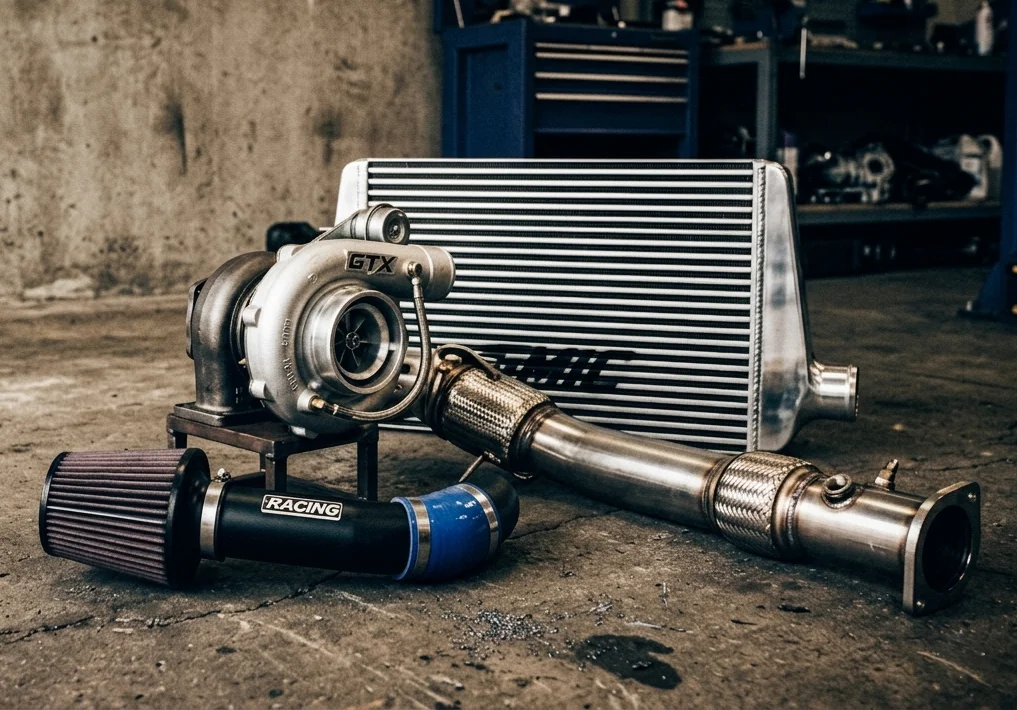
The downpipe is usually the first change on a petrol turbo car. The factory catalytic converter is the single biggest restriction on the exhaust side, and it's replaced with a larger-diameter front section that allows exhaust gases to exit faster with less resistance. This directly reduces the load on the turbine wheel, which spins up more freely and responds faster. You can fit a sports catalyst if you want to keep things road-legal, or a full decat pipe where your local regulations allow it. Either way, the ECU needs recalibrating to handle the changed or removed lambda sensor readings and suppress associated fault codes.
On the intake side, a performance induction kit replaces the full airbox — not just a panel filter swap. Cold-air intake systems draw air from outside the engine bay where it's denser and cooler, improving combustion efficiency at the higher boost levels the remap is targeting.
Depending on the platform, an uprated intercooler with a larger heat exchanger and lower pressure drop may be recommended or necessary. On some cars, an additional cooling radiator is the better approach.
Diesel Engines at Stage 2
Stage 2 on a diesel follows a different hardware path. The key modifications typically centre around the exhaust aftertreatment system rather than a downpipe and sports cat. EGR delete, DPF delete and — on newer Euro 6 vehicles — AdBlue/SCR delete are the hardware changes that open up the exhaust side for a diesel. These remove the components that restrict exhaust flow, increase soot loading and add thermal cycling stress to the engine. The remap then recalibrates fuelling, injection timing and boost to take advantage of the freed-up exhaust.
Uprated intercoolers are just as relevant on diesel platforms, particularly on vehicles used for towing or sustained motorway loads where charge air temperatures climb quickly. On some diesel engines, uprated injectors become part of Stage 2 because the stock units are already near their duty cycle limit once boost is increased.
Important: fitting a DPF delete or decat pipe without a matched remap is not Stage 2 — it's a recipe for fault codes, limp mode and a miscalibrated fuelling strategy. The software and hardware have to move together.
What Stays Standard at Stage 2
The stock turbocharger stays in place at Stage 2. Turbocharger replacement is Stage 3 territory. If you're being told you need a new turbo for Stage 2 on a standard platform, question it.
Maintenance at Stage 2
Stage 2 does require closer attention to servicing. Reduce your oil change intervals and follow the tuner's specific recommendations for your build. Based on the work BSG Automotive carries out, typical gains at Stage 2 are 20–40% over stock — heavily platform-dependent. Stage 2 is still perfectly usable as a daily driver if the parts are quality and the tune is done properly.
What Is a Stage 3 Tune?
The key distinction between Stage 2 and Stage 3 on a turbocharged car is the turbocharger itself. Stage 3 means the stock turbo is replaced with a higher-capacity unit. On a naturally aspirated engine, Stage 3 means adding forced induction entirely — a supercharger or turbocharger where there was none before.
Turbocharger Options at Stage 3
A hybrid turbo retains the OEM housing but is rebuilt with larger internals — a bigger compressor wheel and turbine wheel. This allows greater airflow at the same physical size, giving the ECU room to push fuelling and timing harder while staying within the original installation envelope. Alternatively, a full replacement unit — often with a significantly larger compressor map or variable geometry — replaces the factory turbo entirely.
Water-Methanol Injection
Water-methanol injection is commonly added at Stage 3 to manage thermal load. A 50/50 mix of distilled water and methanol enters the intake manifold alongside the charge air, reducing combustion temperature and lowering the risk of detonation. Use distilled water — mineral content leaves deposits that negate the effect. The system requires precise calibration and dosing; it's not a bolt-on with no tuning consequences.
Transmission and Clutch
Some cars can't absorb Stage 3 torque figures through standard transmission components. On many platforms, gearbox strengthening and clutch replacement become part of the build rather than optional extras. On VAG cars with a DSG gearbox, a TCU (transmission control unit) remap is increasingly standard practice at this stage — and is often worth doing alongside Stage 1 or Stage 2 as well.
Dyno Tuning Is Mandatory
The map at Stage 3 is written live with EGT monitoring, air-fuel ratio measurement and full data logging. Cylinder-by-cylinder calibration replaces the averaged maps used at earlier stages. Getting this wrong means a destroyed engine, not a warning light.
A Note on Factory-Marginal Turbos
Some engines leave the factory with turbos that are already borderline for their rated power — units that barely last their warranty period at stock output. Pushing those with a chip tune at Stage 1 is asking for trouble. A good tuner will identify this and recommend turbo replacement earlier in the process, sometimes skipping the full Stage 2 hardware sequence and going straight to the turbo before anything else. If a shop is willing to remap a known problematic turbo without flagging this risk, walk away.
What Is a Stage 4 Engine Build?
Stage 4 is where the engine is stripped down and the internals replaced. The stock pistons, connecting rods and crankshaft are designed for the factory power output — they are not engineered to sustain boost pressures significantly above factory specification or extended EGT above approximately 980°C on most modern turbo petrol engines. Once your target power figure is more than 40–50% above factory, the standard internals become the limiting factor and eventually the failure point.
Typical Stage 4 Internal Components
Forged pistons with a reduced compression ratio to manage detonation risk at high boost. H-beam or I-beam connecting rods in chromoly steel. Uprated main and big-end bearings. A balanced or replaced crankshaft where required.
The specific parts needed vary by engine. Every engine has its own failure hierarchy — some use strong factory pistons that survive well into high power figures while the connecting rods are a known weak point. A competent tuner will know where your engine sits in that hierarchy and build accordingly.
Daily Driver? Not at Stage 4
Stage 4 takes the car entirely out of daily driver territory. Expect oil changes every 3,000–4,000 miles at most, continuous EGT and boost pressure monitoring, and a minimum fuel requirement of 97–99 RON super unleaded. Realistic engine longevity under hard use drops to 30,000–60,000 miles before major work is due again.
Beyond Stage 4 — Motorsport and Race Builds
True race engines operate on their own internal classification. At this level, the block is typically bored or stroked, titanium rods and ceramic turbines appear, methanol or nitrous injection systems are standard, and the gearbox and driveline are rebuilt to match. ECU calibration is done manually per cylinder on a rolling road, not from averaged maps.
Engine longevity at this level is measured in running hours — 20 to 100 hours before a scheduled rebuild. These are not road vehicles in any meaningful sense, and "Stage 5" or "Stage 6" designations from commercial tuners are marketing labels without technical substance behind them.
Tuning Stages Comparison Table
| Stage 1 | Stage 2 | Stage 3 | Stage 4 | |
|---|---|---|---|---|
| What changes | Software only (ECU remap) | Bolt-on hardware + custom remap | Turbo replacement + supporting mods | Internal engine rebuild |
| Typical gains | 15–25% (turbo) / 5–15% (NA) | 20–40% over stock | 40–60%+ over stock | 50%+ over stock |
| Hardware required | None | Downpipe, intake, intercooler (petrol) / DPF, EGR, intercooler (diesel) | Hybrid or full turbo, water-meth, clutch/gearbox | Forged pistons, rods, bearings, balanced crank |
| Daily driveable | Yes — no compromise | Yes — if built correctly | Possible but demanding | No — track/performance car |
| Maintenance impact | Standard OEM intervals | Reduced oil change intervals | Frequent monitoring required | 3,000–4,000 mile oil changes |
| Fuel requirement | As specified by tuner (usually 97–99 RON) | 97–99 RON super unleaded | 99 RON super unleaded | 99 RON super unleaded minimum |
| Dyno session | Recommended | Yes | Mandatory | Mandatory |
| Approx. cost | £200–£500 | £800–£2,500+ | £3,000–£8,000+ | £5,000–£15,000+ |
Figures are general guidelines based on BSG Automotive's experience across a wide range of petrol and diesel platforms. Actual results vary by engine, condition and specification.
The Honest Take on Stage Labels
The same stage number means something completely different depending on the engine architecture. A 1.6 MPI naturally aspirated engine and a 2.0 TSI turbocharged direct-injection unit have fundamentally different designs — Stage 2 for one might be an intake, exhaust and remap, while Stage 2 for the other might already require a new intercooler and revised fuelling hardware. Power gains vary accordingly: you might see an additional 15 hp on an atmospheric engine versus 70 hp on a turbo unit, both labelled "Stage 2."
What actually matters is the specific list of modifications, the quality of the calibration, and whether the ECU file was written for your engine's actual parameters. On a petrol engine, you can verify this through data logs: stable lambda around 0.85–0.90 at wide-open throttle, no misfires, EGT within safe limits. If those numbers aren't right, the tune needs work — regardless of what stage it claims to be.
Before Any Tuning: Diagnose Your Car First
This is consistent advice from experienced tuners across the board: a remap on a tired engine accelerates every existing problem. Before any stage of tuning, your car should be properly diagnosed — compression test, injector condition, turbo health, sensor readings, static and dynamic checks. A clean bill of health before the remap means the gains are real and your engine can handle them. A hidden issue means the remap finds it the hard way, and that's an expensive lesson.
At BSG Automotive, we run a full diagnostic check before every remap for exactly this reason. If something needs sorting first, we'll tell you before we touch the ECU.
Which Stage Is Right for You?
Stage 1 is the right choice if you're a daily driver wanting real, noticeable gains with no hardware spend or downtime. This is the sweet spot for most road cars — clean power, no visible modifications, and your engine stays within its design tolerances.
Stage 2 is for drivers who want to push further and are willing to invest in quality hardware and a proper dyno session. It's still daily-driveable if built correctly with matched components and a calibration written specifically for your setup.
Stage 3 is a dedicated performance build with a clear goal and a bigger budget. It needs a realistic approach to maintenance, fuel quality and — on some platforms — transmission upgrades. This is where you stop treating the car as basic transport and start treating it as a project.
Stage 4 is track or dedicated performance car territory. If you're considering Stage 4, you already know what you're getting into — and you should be working with a tuner who builds engines, not just remaps them.
The stage number isn't the story. The engineering quality behind it is.
Frequently Asked Questions
Stage 1 tuning is a software-only ECU remap with no hardware modifications. The engine's fuel mapping, ignition timing and boost pressure are recalibrated to safely extract more power from completely standard components. On a turbocharged engine, typical gains are 15–25% over stock output.
A properly written Stage 1 remap on a healthy engine is safe for long-term daily use. The calibration keeps thermal and mechanical loads within OEM design tolerances, which is why no hardware changes or shortened service intervals are required. The key word is "properly written" — a quality calibration from a reputable tuner, not a generic file.
On a petrol turbo car, Stage 2 typically requires a performance downpipe (sports cat or decat), a cold-air intake system and often an uprated intercooler. On a diesel, the hardware path usually involves DPF delete, EGR delete and potentially an intercooler upgrade. Both require a custom remap written to match the specific hardware fitted.
Yes. Any ECU remap — including Stage 1 with no physical modifications — is a declarable modification under UK motor insurance rules. Failing to declare it can void your policy. Specialist insurers often offer reasonable premiums for remapped vehicles.
The defining change at Stage 3 is turbocharger replacement. Stage 2 works within the limits of your factory turbo with supporting bolt-on hardware. Stage 3 replaces the turbo entirely with a higher-capacity unit (hybrid or full replacement), which opens up a significantly higher power ceiling but requires more extensive supporting modifications and mandatory dyno tuning.
A Stage 1 remap typically takes 1 hour including the pre-remap diagnostic check, the flash itself and post-remap testing. Stage 2 and above take longer because hardware needs fitting and the custom calibration is written on the dyno.
BSG Automotive provides mobile ECU remapping across North and West London — from Stage 1 software tunes to full Stage 2 builds with hardware. We carry out a full diagnostic check before every remap, and every calibration is custom-written for your vehicle.
See our ECU Remapping Service for full details, or contact us to discuss which stage is right for your car.