
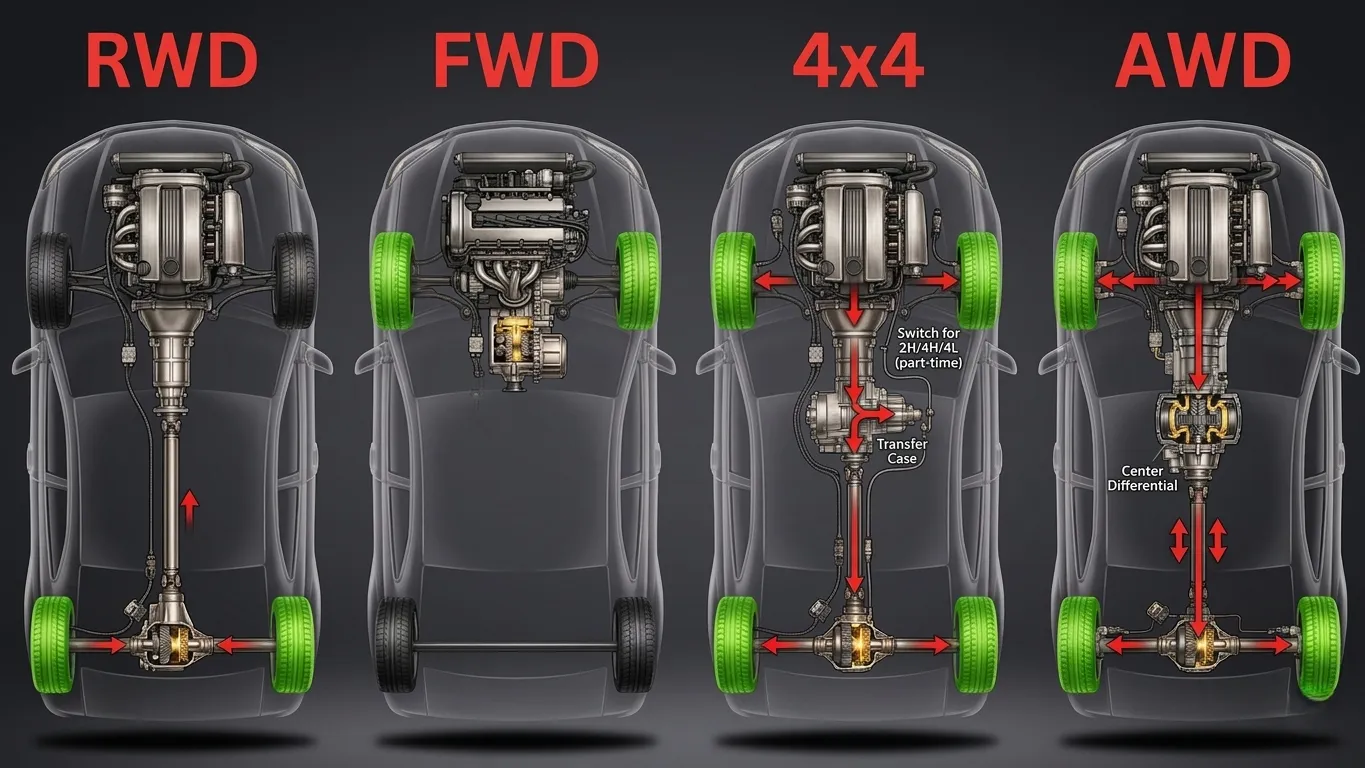
Front-wheel drive (FWD), rear-wheel drive (RWD) and all-wheel drive (AWD) each deliver power to your car's wheels differently — and that single design decision shapes how your vehicle handles, how fuel-efficient it is, what it costs to run and how it performs in rain, snow or on loose surfaces. Whether you drive around North London every day or you want to understand your car's behaviour better before booking a remap or performance upgrade, this guide covers everything you need to know about drive types.
Front-Wheel Drive (FWD) — How It Works
Front-wheel drive means the engine sends power through the transmission to the front wheels only. Those same wheels also steer the car. The layout — engine, gearbox, differential, driveshafts (CV joints) — is compact enough to sit entirely within the front of the vehicle, which frees up space in the cabin and boot.
Because the engine crankshaft can run parallel to the front axle, there is no need for a complex bevel gear in the drivetrain. That simplicity is a big reason why FWD became dominant in mainstream cars from the 1960s onwards. The first mass-produced FWD car is often cited as the Cord L-29, launched in 1929, but it was the postwar era that turned front-wheel drive into the industry standard for affordable family cars.
The critical component in an FWD car is the constant velocity joint — the CV joint (or SHRUS in Russian engineering literature). It transmits torque smoothly to a wheel that is also turning left or right, which is a genuinely clever piece of engineering.
Pros of Front-Wheel Drive
- Predictable, forgiving handling — good choice for everyday driving and less experienced drivers.
- More stable on wet roads and light snow compared to RWD.
- No propshaft or rear differential, so the cabin and boot are larger and the car weighs less.
- Lower purchase price and cheaper to manufacture.
- Mild understeer tendency keeps the car on a predictable line through corners.
Cons of Front-Wheel Drive
- Less dynamic and engaging than RWD — not ideal for drivers who enjoy spirited driving.
- Front tyres wear faster because they handle steering, acceleration and braking simultaneously.
- Power delivery limits — high-horsepower FWD cars suffer torque steer.
- CV joints will eventually wear and require replacement — not the cheapest repair.
- Cramped engine bay can make certain repairs more labour-intensive.
BSG Automotive note: FWD cars respond very well to a Stage 1 ECU remap — you get noticeably better throttle response and mid-range torque without pushing the drivetrain beyond its design limits.
Rear-Wheel Drive (RWD) — How It Works
In a rear-wheel drive car, the engine sends power via a propshaft to a differential at the rear axle, which then drives the rear wheels. The front wheels steer and nothing else. This classic layout — used for the first five decades of motoring — distributes the workload between axles and gives the chassis engineer more freedom to tune handling characteristics.
Almost every premium, sports and performance car uses RWD or AWD as a baseline. The reason is simple: separating steering from drive creates a fundamentally more balanced platform.
Pros of Rear-Wheel Drive
- Near 50:50 weight distribution — better balance and sharper handling.
- Faster off the line — weight transfers rearward under acceleration, improving rear traction.
- Tighter turning circle thanks to a simpler front suspension design.
- More even tyre and brake wear across all four corners.
- Better for steep climbs — extra load on the driven wheels improves grip.
- Smoother, more refined ride with less vibration through the steering wheel.
Cons of Rear-Wheel Drive
- Prone to oversteer on slippery surfaces — requires more driver skill in winter conditions.
- More components (propshaft, rear diff) means higher initial cost and more maintenance.
- Slightly heavier — propshaft adds weight, which can increase fuel consumption.
- The propshaft tunnel reduces rear-passenger legroom and boot space in some models.
BSG Automotive note: RWD platforms — especially BMW, Mercedes and Jaguar — are prime candidates for ECU remapping. The balanced weight distribution means more of that extra power actually reaches the road.
All-Wheel Drive and 4WD — How They Work
All-wheel drive sends torque to all four wheels. That is where the simple definition ends, because there are three meaningfully different systems on the market:
- Part-time 4WD — manually engaged (usually via a lever or button). Designed for serious off-road use. Do not use on dry tarmac.
- Full-time 4WD — permanently engaged with a centre differential. Found on serious SUVs and some performance cars.
- AWD (Torque-on-demand) — the system you find in most modern crossovers and performance cars. Electronics monitor wheel slip and automatically transfer torque front-to-rear or side-to-side as needed. No driver input required.
AWD vs 4WD — Which Is Better?
AWD suits daily driving in mixed UK conditions — wet A-roads, motorways, light gravel. It works transparently in the background and requires no driver input. 4WD suits genuine off-road work: deep mud, uneven terrain, slow-speed crawling. On dry motorways, full-time 4WD increases tyre wear and fuel consumption. AWD systems are typically more expensive to repair due to electronic complexity.
| System | Best Use Case | Fuel Economy | Repair Cost |
|---|---|---|---|
| FWD | City & everyday driving | Best | Lowest |
| RWD | Performance, sporty driving | Good | Moderate |
| AWD | Mixed roads, light off-road | Moderate | High |
| 4WD (part-time) | Serious off-road use | Lowest (when engaged) | Moderate–High |
Pros of All-Wheel Drive
- Superior traction on wet, icy and loose surfaces.
- Better stability and reduced risk of understeer or oversteer.
- Faster 0–60 times than equivalent FWD or RWD setups at high power levels.
Cons of All-Wheel Drive
- Higher purchase price and running costs.
- Heavier drivetrain increases fuel consumption.
- Four-wheel oversteer is harder to control if it occurs.
- Not all garages are equipped to service complex AWD systems.
BSG Automotive note: AWD platforms such as Golf R, Audi S3 and BMW xDrive models show excellent gains from ECU remapping — the four-wheel traction means the extra power translates cleanly to acceleration rather than wheelspin.
Which Drive Type Is Best in Winter?
UK winters rarely produce the kind of deep snow that makes FWD vs RWD a life-or-death question, but wet leaves, standing water and light frost are a different matter. Here is how each type behaves:
- FWD — most forgiving in everyday winter conditions. The weight of the engine over the driven wheels helps traction. Understeer tendency keeps the car safe for most drivers.
- RWD — requires more respect on slippery surfaces. Modern stability control systems compensate well, but a heavy right foot in a powerful RWD car on ice is asking for trouble.
- AWD/4WD — best traction of all. Important caveat: more grip does not mean better braking. AWD cars still need winter tyres and sensible speeds.
Which Drive Type Is Best Off-Road?
For genuine off-road use — fields, forest tracks, loose gravel, deep mud — permanent 4WD wins clearly. AWD comes second for light off-road use (farm tracks, gravel driveways). FWD and RWD were not designed for off-road work and should not be pushed beyond firm surfaces.
Which Drive Type Is Best for a Performance Car?
The answer depends on the kind of performance you want. RWD is the traditional choice for sports cars: the driver can use throttle to adjust the car's attitude mid-corner — and, yes, drift. AWD has become the preferred choice for high-power road cars (Nissan GT-R, Porsche Turbo, Audi RS models) because it turns extreme horsepower into traction more reliably. There are impressive FWD hot hatches — the Honda Civic Type R holds track records — but FWD has clear physical limits above around 300bhp.
Repair and Maintenance Costs by Drive Type
As a rough guide for UK owners:
- FWD — CV joint replacement is the most common drivetrain repair. Expect to pay £150–£350 per side at an independent garage.
- RWD — propshaft, rear diff and driveshaft repairs are relatively straightforward. Rear diff rebuilds can be expensive on performance cars.
- AWD — the most complex and expensive to repair. Electronic coupling units, Haldex pumps and centre diff rebuilds can cost £500–£2,000+. Always choose a specialist.
Which Drive Type Should You Choose?
There is no universally correct answer — it depends on how and where you drive. Here is the quick guide:
- Choose FWD if you mainly drive in the city, want lower running costs and do not need high performance.
- Choose RWD if you enjoy driving, want balanced handling and are confident managing the car in poor conditions.
- Choose AWD if you regularly drive on mixed or rural roads, need traction in winter and are willing to pay more to run the car.
- Choose 4WD if you genuinely go off-road and need maximum traction at low speeds.
Frequently Asked Questions
Can you convert a FWD car to AWD?
In theory, yes — if the manufacturer produces both FWD and AWD versions of the same model, the required components exist. In practice, it means replacing the gearbox, adding a transfer case, propshaft, rear axle and differential. The labour cost almost always exceeds the value of the modification. For the vast majority of owners, selling the FWD car and buying an AWD version is far more sensible.
Is AWD the same as 4WD?
Not exactly. AWD typically refers to electronically-controlled torque-on-demand systems that work automatically and suit road driving. 4WD usually refers to manually-engaged systems with a low-range transfer case, intended for off-road use. Some manufacturers use the terms interchangeably, so always check the technical specification.
Does drive type affect fuel economy?
Yes. FWD cars are typically the most fuel-efficient because they are lighter and mechanically simpler. RWD adds a small weight penalty. AWD and 4WD add the most weight and mechanical drag, so fuel consumption is highest — often 10–15% more than an equivalent FWD version in real-world driving.
Which drive type is safest for new drivers?
FWD is generally considered the safest starting point. The tendency towards understeer (the front of the car pushing wide in a corner) is more predictable and easier to manage than the oversteer (rear stepping out) that RWD cars can produce. Modern stability control systems have reduced the gap significantly, but FWD remains the most forgiving choice.
Whichever drive type your car uses, a properly calibrated ECU remap can improve throttle response, mid-range torque and fuel efficiency. BSG Automotive tunes FWD, RWD and AWD vehicles across West and North London — mobile service, diagnostics included.
See our ECU Remapping Service for full details, or contact us to discuss your vehicle.