
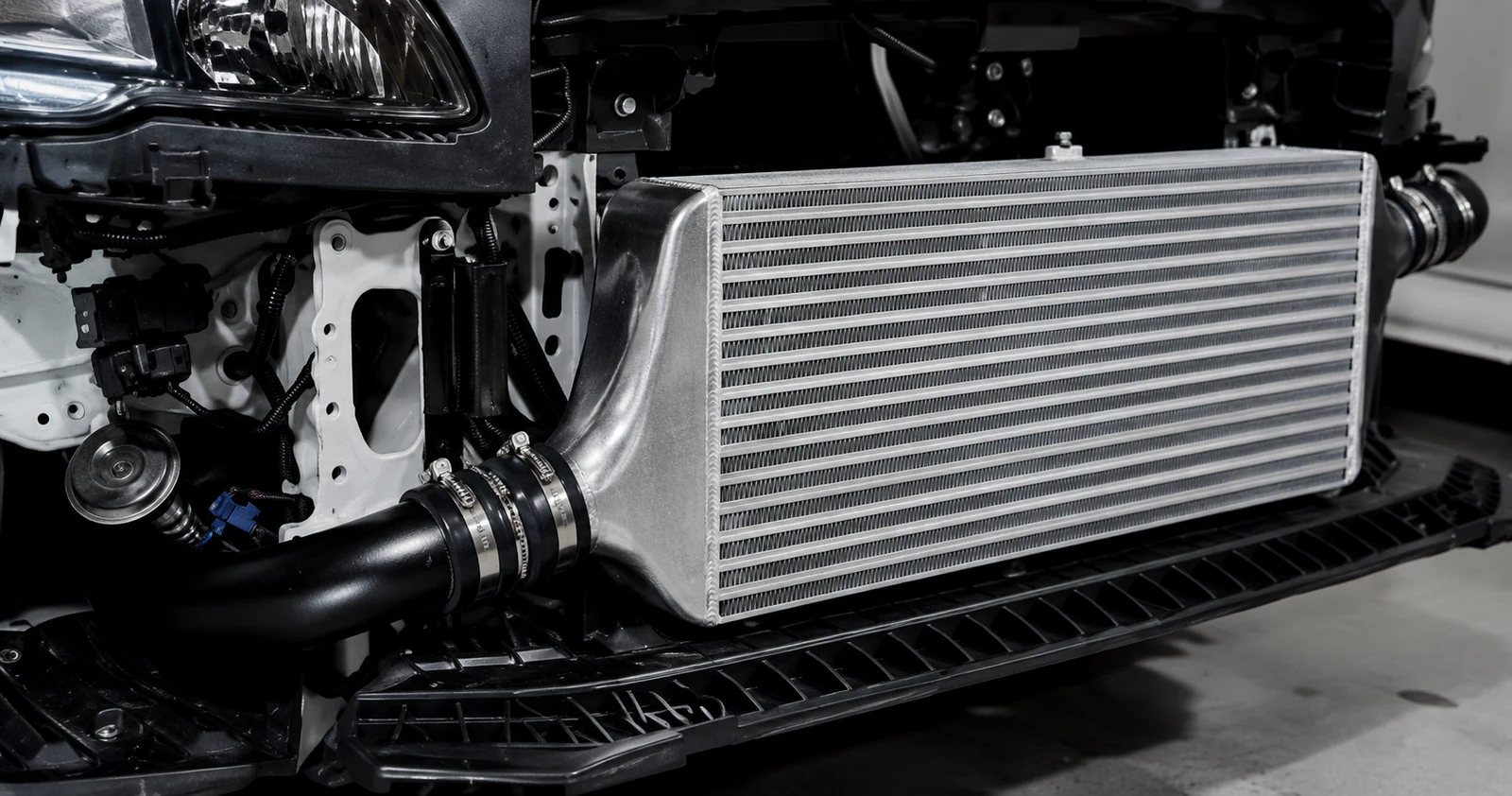
An intercooler upgrade is worth considering when the existing system cannot keep charge-air temperatures under control for the way you use the car. That might be repeated track sessions, a higher-output calibration or a larger turbo. It does not mean every remapped car needs one, or that a bigger core will automatically add power.
For a standard daily driver, the sensible starting point is the condition of the existing system. Before spending money, understand what the intercooler does, what an upgrade can change and which measurements would show a genuine benefit.
What is an intercooler, and what does it do?
An intercooler is a heat exchanger that cools compressed intake air before it enters the engine. It sits in the airflow path between the turbocharger's compressor and the intake manifold. Similar cooling arrangements are also used with some supercharged engines.
Compressing air raises its temperature. Cooling it afterwards increases its density at a given pressure, so a given volume can contain more air. The oxygen percentage does not increase; there can simply be more oxygen in that volume because the air is denser. NRF's technical explanation describes this relationship between compression, temperature and charge-air cooling.
The intercooler does not create boost. That is the compressor's job. If you want the background, our guide to how turbochargers work explains the difference between the exhaust-driven turbine and the compressor feeding the engine.
An intercooler and an engine radiator do different jobs. The engine radiator removes heat from engine coolant. An air-to-air intercooler removes heat from the intake air. They may look similar and sit close together, but they are not interchangeable.
How does an intercooler work?
In an air-to-air system, hot compressed air travels through sealed passages inside the intercooler. Cooler outside air passes across separate passages and fins. Heat moves through the metal between them; the two air streams do not mix.
The simplified intake route is: air filter, turbocharger compressor, intercooler, intake manifold, engine. Exact layouts vary. An intercooler may be mounted at the front of the car or elsewhere with ducting to supply cooling air.
An air-to-water system, also called an indirect charge-air cooling system, transfers heat from the intake air into coolant. A pump circulates that coolant through a separate cooling circuit, with a low-temperature radiator rejecting the heat to outside air. It is the complete circuit that needs to work properly, not just the charge cooler itself.
MAHLE describes both direct and indirect charge-air cooling. Neither layout makes an upgrade automatically necessary. With an indirect system, a cooling problem may involve coolant circulation or the low-temperature radiator, rather than the charge cooler core.
For either arrangement, good cooling depends on heat transfer and adequate airflow. A large component hidden behind poor ducting is not necessarily an effective installation.
What is intercooler heat soak?
Heat soak describes the build-up of heat in the cooling system and surrounding components. Under repeated or sustained load, the system may not reject heat quickly enough to maintain the same outlet-air temperature. The first acceleration can therefore tell a different story from later runs.
That is why repeatability matters. An upgraded system may be useful because it maintains lower temperatures over repeated operation, even where the first run produces little difference in peak power. The effect on engine output depends on the engine, its calibration and the operating conditions.
Garrett's intercooler development information uses repeated-load testing to assess temperature behaviour. Its published results relate to a particular modified vehicle and test; they are not a prediction for every turbocharged car.
A high intake-temperature reading after sitting in traffic does not, on its own, prove that the intercooler is undersized. Check where the sensor is fitted and what happens once airflow and load change. Compare like-for-like conditions rather than treating one dashboard number as a diagnosis.
When is an intercooler upgrade worth it?
The strongest reason to upgrade is evidence that the current system limits the intended setup. The following is a practical decision guide, not a universal specification for every engine.
| Your situation | Sensible starting point |
|---|---|
| Standard daily driver | Keep a healthy original system unless testing shows a cooling limitation. |
| Remapped turbo petrol or diesel | Check the calibration's hardware requirements and temperature behaviour under the intended load. |
| Repeated track sessions | Assess sustained cooling and recovery between runs, not just peak power. |
| Larger turbo or substantially higher airflow | Evaluate cooling capacity and pressure loss as part of the complete intake system. |
| Damaged or leaking intercooler | Repair the fault. Decide separately whether an upgraded replacement is justified. |
A car used mainly for short, gentle journeys has a different demand from one driven through repeated high-load sessions. Buying the same part as a heavily modified car does not establish that your own car will benefit.
Likewise, a tuning-stage label is not enough information. “Stage 2” does not describe one agreed boost level, power output or hardware list. Our guide to car tuning stages explains why the actual calibration and supporting parts matter more than the label.
If the budget is limited, fix faults and overdue maintenance first. An intercooler should solve a defined cooling or flow requirement, rather than displace tyres, brakes or necessary repairs. See our guide to what to modify first on a car for the wider order of priorities.
Does an intercooler upgrade add horsepower?
It can support more power or help maintain existing performance, but there is no fixed horsepower gain. The result depends on the restriction and cooling performance of the original part, the replacement design, engine airflow and calibration.
There is a useful distinction between making a higher peak figure and avoiding a drop as temperatures build. A before-and-after comparison should show both. One cold run followed by a hot run is not a fair test of two different intercoolers.
Be careful with product descriptions such as “supports 600 hp”. That describes a supplier's claimed application capacity under particular assumptions. It does not mean the part adds that power, or that it is the best choice for an engine producing much less.
If power results are quoted, check whether they are measured at the wheels or stated at the engine, which units are used and whether fuel or software changed between tests. Our torque and horsepower guide explains how to read those figures without confusing different measurements.
Is a bigger intercooler always better?
No. Size is only one part of the design. The internal passages, fins, end tanks and external airflow all affect how well the intercooler works.
Air loses pressure as it passes through a restrictive core. If the control system maintains the same intake-manifold boost target, extra restriction can increase the pressure the compressor needs to produce upstream. Cooling performance therefore needs to be considered alongside pressure loss, not in isolation.
Garrett's core engineering information explains the balance between fin density, heat transfer and pressure drop. A bigger external dimension does not tell you which core has the better balance at your engine's airflow.
Fitment matters too. Check that the kit preserves suitable airflow through the front cooling pack and that its mounting points, hoses and connections suit the exact car. With an indirect system, establish whether the proposed part is the charge cooler, the low-temperature radiator or a combination.
Extra pipework and internal volume are also worth considering when evaluating transient response. Do not assume every larger intercooler causes noticeable lag, or that all kits respond identically. Look for application-specific testing and a sensible installation, rather than judging by appearance.
What should you check before buying?
Start with the existing system. Inspect accessible hoses, connections, mounting points and the core for damage. Check for blocked external fins and missing or poorly fitted ducting. A suspected boost leak needs proper testing; fitting a larger core will not repair a split hose elsewhere.
For an indirect system, follow the manufacturer's checks for coolant level, leaks, pump operation and bleeding. Do not open a hot cooling system. If the car has lost performance or developed warning lights, diagnose those symptoms before choosing an upgrade.
Then ask for useful evidence. A meaningful comparison should record:
- Ambient and charge-air temperatures: identify the sensor location, since different positions measure different conditions.
- Comparable operating conditions: engine speed, load, boost, fuel and calibration should be documented.
- Repeated-load behaviour: include how temperatures change over several runs and during recovery.
- Pressure loss where measured: establish the airflow and measurement points behind the result.
- The exact vehicle and installation: engine variant, other modifications and test airflow all matter.
Use a suitably equipped workshop or controlled test environment for high-load comparisons. There is no need to reproduce a supplier's acceleration testing on public roads.
There is also no universal intake-temperature threshold that proves every car needs an upgrade. Compare the results with the requirements of the particular engine and calibration. If the seller only provides a core size and a claimed power capacity, ask for more evidence before treating it as a performance improvement.
Should you upgrade yours?
Keep the original intercooler if it is healthy and meets the car's needs. Repair leaks or cooling faults before looking for extra performance. Where repeatable testing shows that charge-air cooling is limiting the intended setup, choose a properly matched upgrade with credible temperature and flow data. The useful question is not how large it looks behind the bumper, but what problem it will solve on your car.
Frequently asked questions
Do I need an upgraded intercooler for a Stage 1 remap?
Not automatically. Check the requirements of the specific calibration, the condition of the original cooling system and how the car will be used. Some setups may justify an upgrade; the words “Stage 1” alone do not establish that need. Discuss hardware requirements before the remap is written.
Does fitting an intercooler require a remap?
There is no single answer for every kit and engine. A replacement cooler does not itself command extra boost or fuel. Confirm compatibility with the kit manufacturer and calibration provider, especially if sensors, pipework or other hardware change. Do not assume fitting the part automatically unlocks extra power.
Can an intercooler upgrade help a diesel engine?
Yes, charge-air cooling is relevant to turbocharged diesels as well as petrol engines. Whether an upgrade is worthwhile depends on the existing system, airflow demand, calibration and use. It is not a general cure for poor performance, and it does not establish a guaranteed improvement in fuel consumption.
Can a larger intercooler affect turbo response?
It can, depending on the total system design. Internal volume, pipework and restriction need to be considered together. Larger external dimensions alone do not predict the result. Use evidence for the particular installation rather than assuming every large core will either improve or worsen response.
Planning a remap? Send BSG Automotive your registration, engine details, mileage, current modifications and intended use. Include any temperature logs or fault codes you already have. We can discuss the checks needed before tuning and the hardware requirements of the proposed calibration. Contact BSG Automotive or read about our Stage 1 remapping service.
You might also like
- What is a turbocharger and how does it work?
- What should you modify first on a car?
- Car tuning stages explained
Sources and further reading
Technical sources checked on 24 October 2026. Manufacturer information is used for operating principles and design considerations; product-specific results are not presented as guaranteed gains.