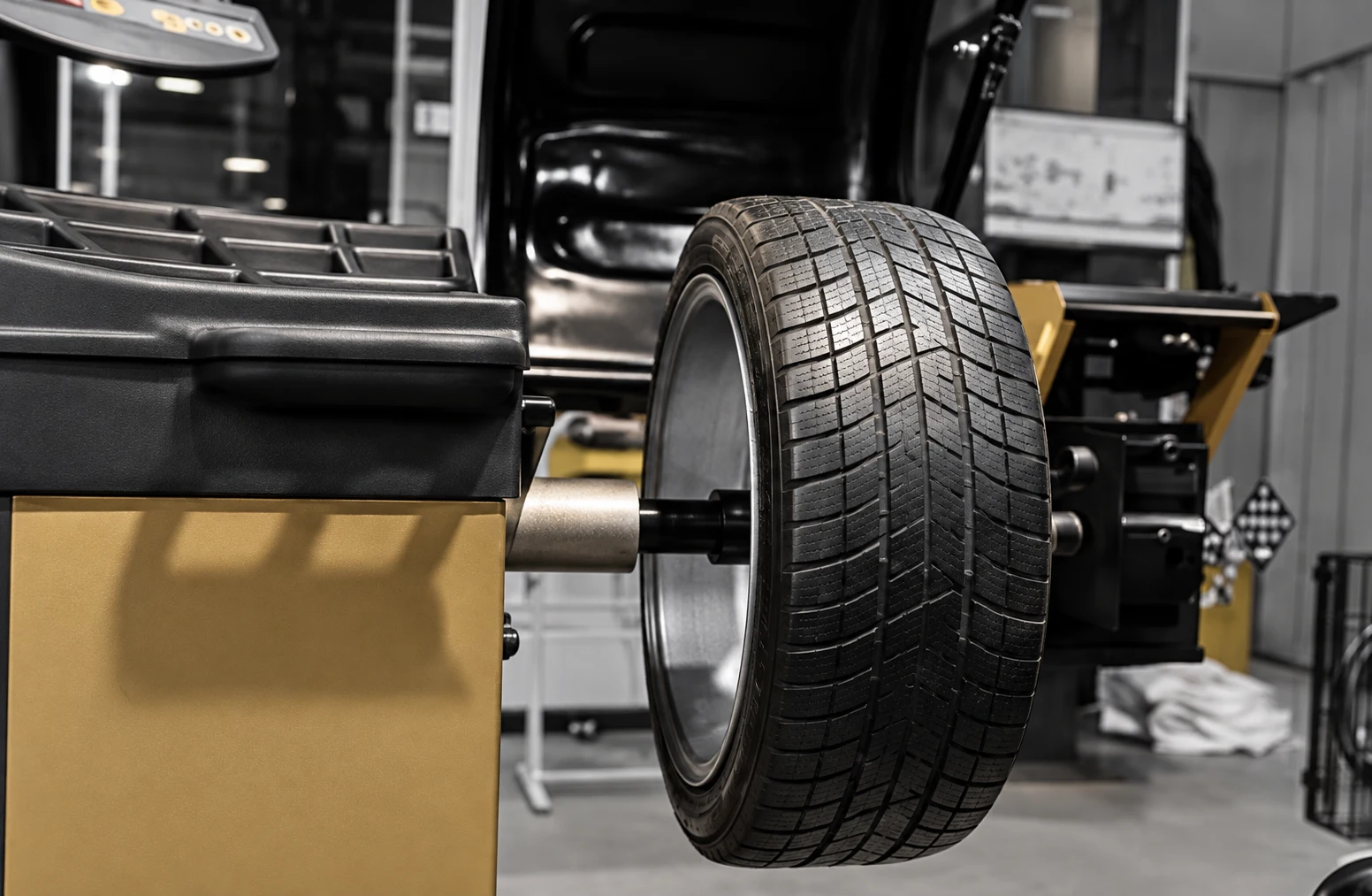
Wheel balancing corrects uneven mass distribution in a tyre and wheel assembly. Wheel alignment checks and adjusts the angles at which the wheels sit and point, using the vehicle manufacturer’s specifications. They solve different problems, so one cannot replace the other.
A shake that appears at certain road speeds can point towards a wheel or tyre problem. Pulling, an off-centre steering wheel or uneven tread wear can justify an alignment check. But these are clues, not diagnoses: tyre damage, incorrect pressures and worn components can produce similar complaints. The useful question is what needs checking before you pay for an adjustment.
1. Wheel balancing and alignment at a glance
| Wheel balancing | Wheel alignment | |
|---|---|---|
| What is measured? | Imbalance in the rotating tyre and wheel assembly | Wheel angles and their relationship to the vehicle and each other |
| What is changed? | Small correction weights are fitted in calculated positions | Available steering or suspension adjustments are set to specification |
| Common reason for a check | Vibration at certain speeds, or a newly fitted tyre | Uneven wear, pulling, an off-centre steering wheel or relevant suspension work |
| What will it not repair? | A damaged tyre, bent wheel or worn suspension joint | A missing balance weight, damaged tyre or worn suspension joint |
Your car can need either service, both, or a different repair. Michelin’s explanation of balancing and alignment makes the distinction between correcting the rotating assembly and setting suspension geometry.
2. What does wheel balancing actually do?
A tyre and wheel are not perfectly uniform. Small differences in mass around the assembly can create forces as it rotates. The car may transmit those forces through the steering wheel, seat or floor, often more noticeably within a particular speed range.
During balancing, the technician mounts the assembly on a balancing machine. After measurement, the machine indicates the size and position of the correction weights. The assembly is checked again after the weights are fitted. Correct centring on the machine matters: an inaccurate mounting can produce a misleading result.
The weights may clip onto a suitable wheel flange or adhere to the wheel barrel. They compensate for imbalance; they do not straighten the rim or repair the tyre. Hunter’s balancing guidance also distinguishes imbalance from wheels and tyres that do not run true.
Static and dynamic imbalance
Static imbalance produces a net imbalance around the wheel’s rotational axis. Dynamic balancing also addresses imbalance distributed across the width of the assembly, which can create a rocking effect as it rotates. A modern balancing machine can calculate corrections in two planes, rather than treating every problem as a single heavy spot needing one weight directly opposite it.
Continental describes the different balancing methods. For an owner, the practical point is that weight position matters as well as the total weight fitted.
Why can a balanced wheel still vibrate?
A satisfactory balance reading does not prove that the complete assembly will roll smoothly under load. A wheel can have excessive runout — movement away from a true circular path — and a tyre can vary in stiffness around its circumference.
A road-force test uses a loaded roller against the tyre to measure behaviour that a conventional balance check may miss. Depending on the results, repositioning the tyre on the rim can reduce the combined variation. This is sometimes called match mounting. It is a measured correction, not a guarantee that every tyre and wheel can be made acceptable.
Hunter’s Road Force manual explains this process and when component replacement may still be necessary. Persistent vibration after balancing deserves further investigation, rather than repeated balancing without a diagnosis.
3. What does wheel alignment change?
Alignment concerns suspension geometry: the angles of the wheels in relation to the vehicle and the road. The target is the correct specification for that car, not simply making every wheel perfectly vertical or every reading zero.
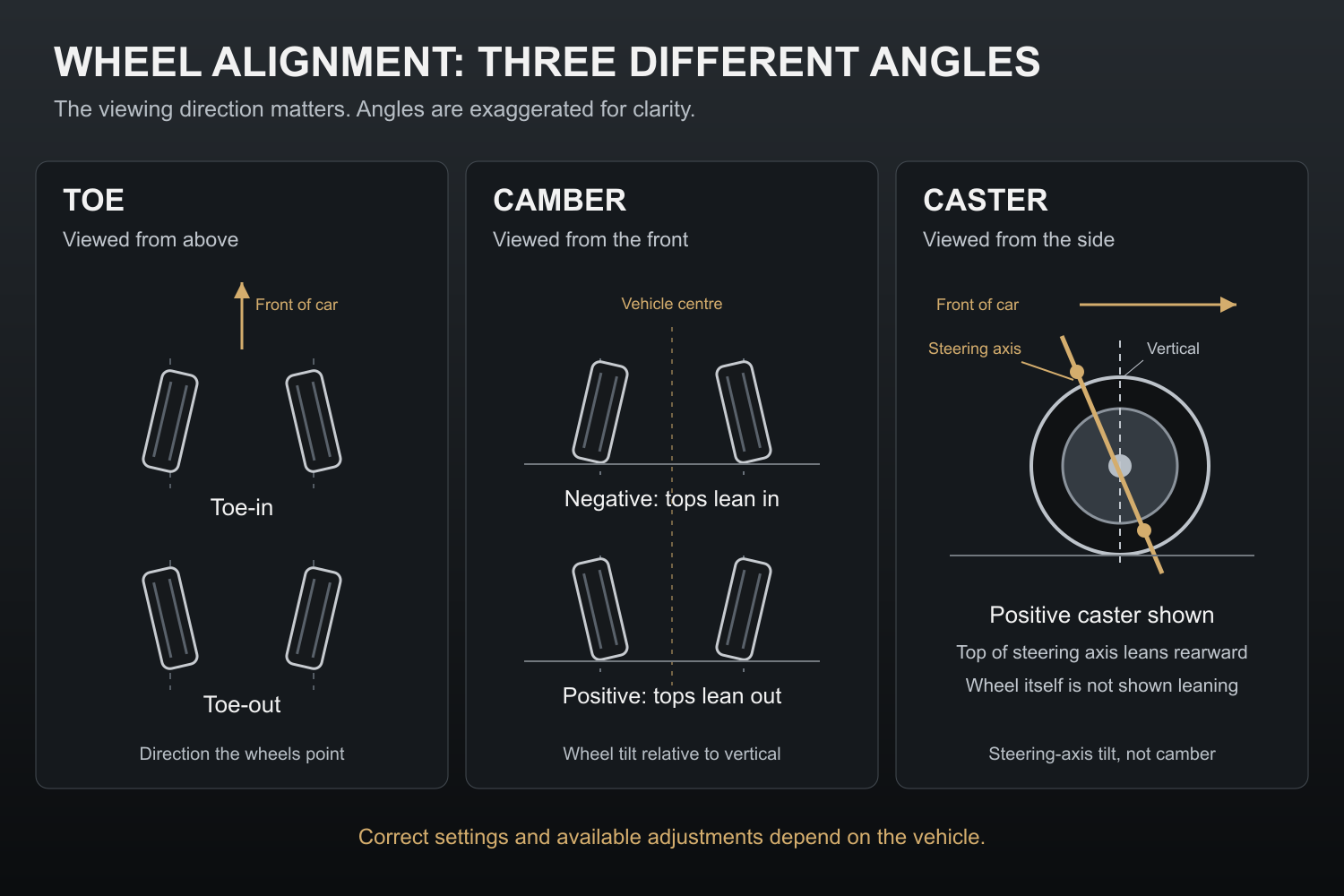
The three familiar terms are toe, camber and caster. They describe different views of the wheel or steering axis.
Toe: where the wheels point
Viewed from above, toe describes whether the fronts of the wheels point towards each other or away from each other. These conditions are called toe-in and toe-out. Incorrect toe can make the tyres scrub as they roll and contribute to uneven wear.
Camber: how the wheels lean
Viewed from the front, negative camber means the top of the wheel leans towards the car; positive camber means it leans outwards. Some negative camber can be part of the intended factory setting. Its presence alone does not prove a fault.
Caster: the steering axis angle
Viewed from the side, caster describes the fore-and-aft inclination of the steering axis. It influences steering behaviour, including stability and the tendency to return towards straight ahead. It is not the visible inward or outward lean of the tyre.
MOOG’s alignment overview explains these measurements. Their specified values depend on the vehicle; copying settings from another car is not a sound starting point.
Can every angle be adjusted?
No. Some vehicles provide straightforward toe adjustment but limited or no routine camber or caster adjustment. An out-of-specification reading may call for investigation of wear, damage, incorrect parts or ride height before any further action.
As MOOG’s guidance on limited-adjustment vehicles explains, the manufacturer’s procedure comes first. An alignment appointment cannot correct a loose joint or bent component simply by changing the settings elsewhere.
4. What do vibration, pulling and tyre wear tell you?
Describe when the symptom happens, rather than booking a service solely by its name. Does the shake follow road speed? Does it appear only under braking? Did it start immediately after a tyre change or impact? These details help separate different causes.
| What you notice | Useful next check |
|---|---|
| A shake at a particular road speed | Tyre and wheel condition, mounting and balance; investigate runout or road-force variation if needed |
| Vibration mainly when braking | Brake and hub inspection, alongside relevant suspension checks |
| An off-centre steering wheel | Geometry measurement and steering-centre checks, with tyre and suspension condition assessed |
| Unusual wear on one shoulder | Pressures, tyre condition and suspension geometry |
| Scalloped or patchy wear | A broader tyre, wheel and suspension inspection; do not diagnose one failed part from the pattern alone |
Brake judder is a useful example of why “shaking means balancing” is too simple. Variations in brake-disc thickness and disc or hub runout can cause vibration during braking. Ferodo’s brake-judder guidance explains these separate mechanisms.
Wear patterns also need context. Incorrect inflation changes how the tyre carries its load, while geometry and suspension problems can produce other forms of uneven wear. Michelin’s tyre-wear guide is a useful reference, but a photograph of worn tread is not a complete mechanical diagnosis.
A pull is not proof of misalignment either. Road slope and tyre behaviour can affect the direction the car tends to follow. Report whether the complaint changes between roads, but keep control of the steering wheel; a hands-off test is unnecessary.
If vibration becomes severe, steering suddenly changes or a tyre appears damaged, stop somewhere safe and arrange an inspection. Do not continue at speed to see whether the symptom disappears. GOV.UK’s vehicle-safety guidance includes tyre condition and pressure checks and makes clear that a vehicle must remain safe between MOT tests.
5. What should a proper alignment check include?
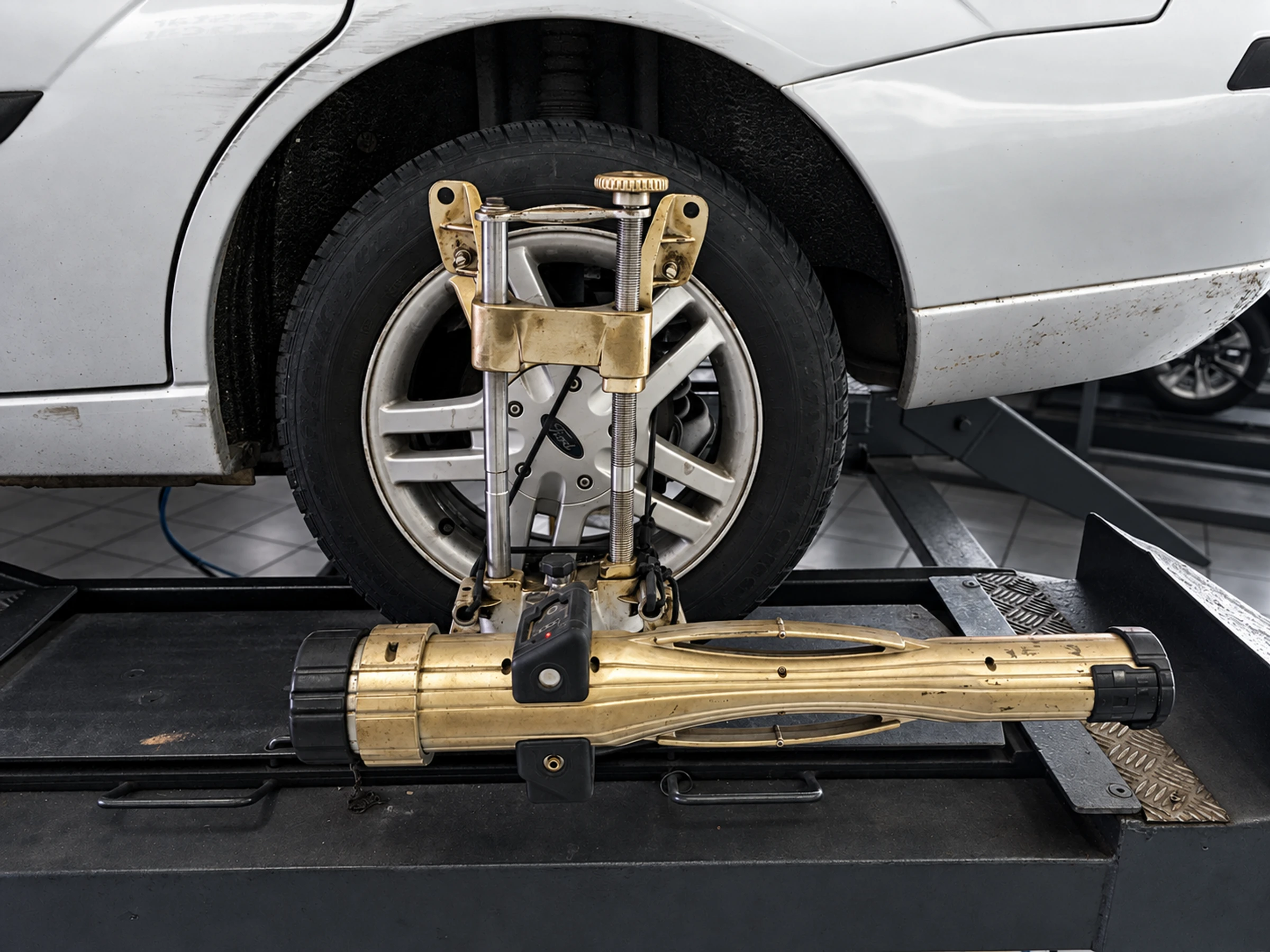
Before adjustment, the workshop needs the correct specification for the vehicle and a sound mechanical starting point. Ask whether the quote includes inspection, measurement and adjustment, or measurement alone.
Tyre pressures, tyre condition, suspension wear and the prescribed vehicle setup matter. Some manufacturers specify ride-height or loading conditions. As one example, Tesla’s Model Y alignment procedure includes setup and steering-centre checks. Its instructions are for that model, not a universal procedure for every car.
The workshop then measures the geometry, adjusts what the vehicle permits and records the result. Ask for a before-and-after report identifying the vehicle specification used and any measurements that remain outside it. A coloured printout is useful evidence, but it should come with an explanation of what was changed and what could not be corrected.
Tracking, two-wheel and four-wheel alignment
“Tracking” is often used loosely when discussing alignment. Ask the workshop exactly what it measures and adjusts. A front adjustment and a check that considers all four wheels are not necessarily the same service.
Measuring the rear wheels helps establish their relationship to the front. The rear wheels’ direction of travel is described by the thrust line; its angle relative to the vehicle’s centreline is the thrust angle. Four-wheel measurement can therefore be useful even on a car with limited rear adjustment. It does not mean the car must have four-wheel drive.
The Hunter WinAlign manual explains thrust-line measurements and alignment procedures.
Steering sensors and driver-assistance systems
Some vehicles also require a steering-system reset or checks relating to advanced driver-assistance systems (ADAS). The requirement depends on the model and the work performed. It should be established from current manufacturer information, not assumed for every car or dismissed because the steering wheel looks straight.
Hunter’s ADAS equipment guide illustrates why requirements vary. Ask whether any required reset or calibration is included in the quotation.
6. When should you book balancing or alignment?
Have a tyre balanced when it is fitted or refitted to a wheel. Arrange an inspection if a new vibration develops, especially after tyre work or an impact. A pothole may damage a tyre or wheel; rebalancing alone should not be assumed to put it right.
An alignment check is sensible when there is abnormal wear, a change in steering behaviour, relevant steering or suspension work, or an impact that may have affected the geometry. New tyres are also a useful opportunity to check the settings before uneven wear develops.
There is no single alignment mileage interval that suits every car and driver. Follow the vehicle’s maintenance information and respond to changes in condition. Continental’s alignment guidance distinguishes these reasons for inspection from a universal fixed schedule.
For a modified car, tell the workshop about changes to the suspension, ride height, wheels and tyres before booking. The setup must suit the actual configuration. Our guide to choosing your first car modifications explains where tyres and chassis condition fit into a wider upgrade plan.
7. Do you need both services — and what should a quote include?
You do not automatically need both adjustments every time. New tyres need balancing; an alignment measurement can establish whether geometry adjustment is also necessary. If a car has a vibration and abnormal tread wear, both areas may deserve investigation, but that still does not establish the cause before inspection.
When comparing UK quotes, ask for a clear breakdown:
- Is balancing priced per wheel, and are correction weights included?
- Does alignment include measurement only, front adjustment or all available adjustments?
- Are a before-and-after report and any required steering-system reset included?
- Would road-force testing, seized adjusters, replacement parts or ADAS calibration cost extra?
- Is the quoted total inclusive of VAT?
These questions make quotations easier to compare than a headline price. Confirm the likely appointment length with the workshop too, particularly where inspection may uncover repairs that need to come first.
8. Start with the symptom, then choose the work
Tell the workshop what the car does, when it happens and what changed before it started. Bring any previous alignment report and mention recent tyre fitting, pothole impacts or suspension work. Ask for findings before agreeing to additional adjustments or replacement parts. A useful result is an explanation of the fault and the work needed to address it, rather than a package of services selected before anyone has checked the car.
Frequently asked questions
Will wheel alignment stop motorway vibration?
Only if the diagnosed cause is something the alignment work can address. Do not treat alignment as a general cure for speed-related vibration. Tyre and wheel condition, mounting, balance and other relevant components need checking. A satisfactory alignment report does not rule out a separate rotating-assembly problem.
Can alignment repair tyres that have already worn unevenly?
No. Correcting the cause will not replace missing tread. The tyres need a separate condition assessment, and replacement may be necessary. Ask whether the existing wear is likely to affect comfort or behaviour even after the geometry has been corrected.
Is tyre rotation the same as wheel balancing?
No. Rotation changes where wheel and tyre assemblies are fitted on the car. Balancing corrects imbalance within an assembly. Permitted rotation patterns depend on the vehicle and tyre configuration; directional tyres and different front and rear sizes can limit the options. Follow the applicable instructions.
Should all alignment readings be zero?
No. The target is the manufacturer’s specification for the correct vehicle variant and setup. Designed-in camber, caster or toe can be intentional. Ask the workshop to explain the target range and any remaining out-of-specification reading rather than judging the report by whether the numbers are zero.
Discuss the next step with BSG Automotive
If your car shakes, pulls or wears its tyres unevenly, contact BSG Automotive with your registration, symptoms and details of recent tyre or suspension work. Explain when the problem occurs and ask about the appropriate next step and service availability before booking. Photos of unusual wear and previous workshop reports can help describe the concern.
You might also like
- Choosing your first car modifications — why tyre and chassis condition matter before adding power.
- Buying a used car in the UK — placing steering behaviour and tyre condition within a broader inspection.
Sources and further reading
Wheel-alignment image: photograph by Mike Peel (original), CC BY-SA 4.0. BSG colour treatment and AI-assisted enhancement; enlarged for display. Adaptation shared under the same licence. Original photographed in Brazil.

Technical sources are linked beside the relevant explanations. For tyre rotation, see Michelin’s rotation guide. Vehicle-specific settings, permitted adjustments and calibration procedures must come from the manufacturer’s information for the actual car.