
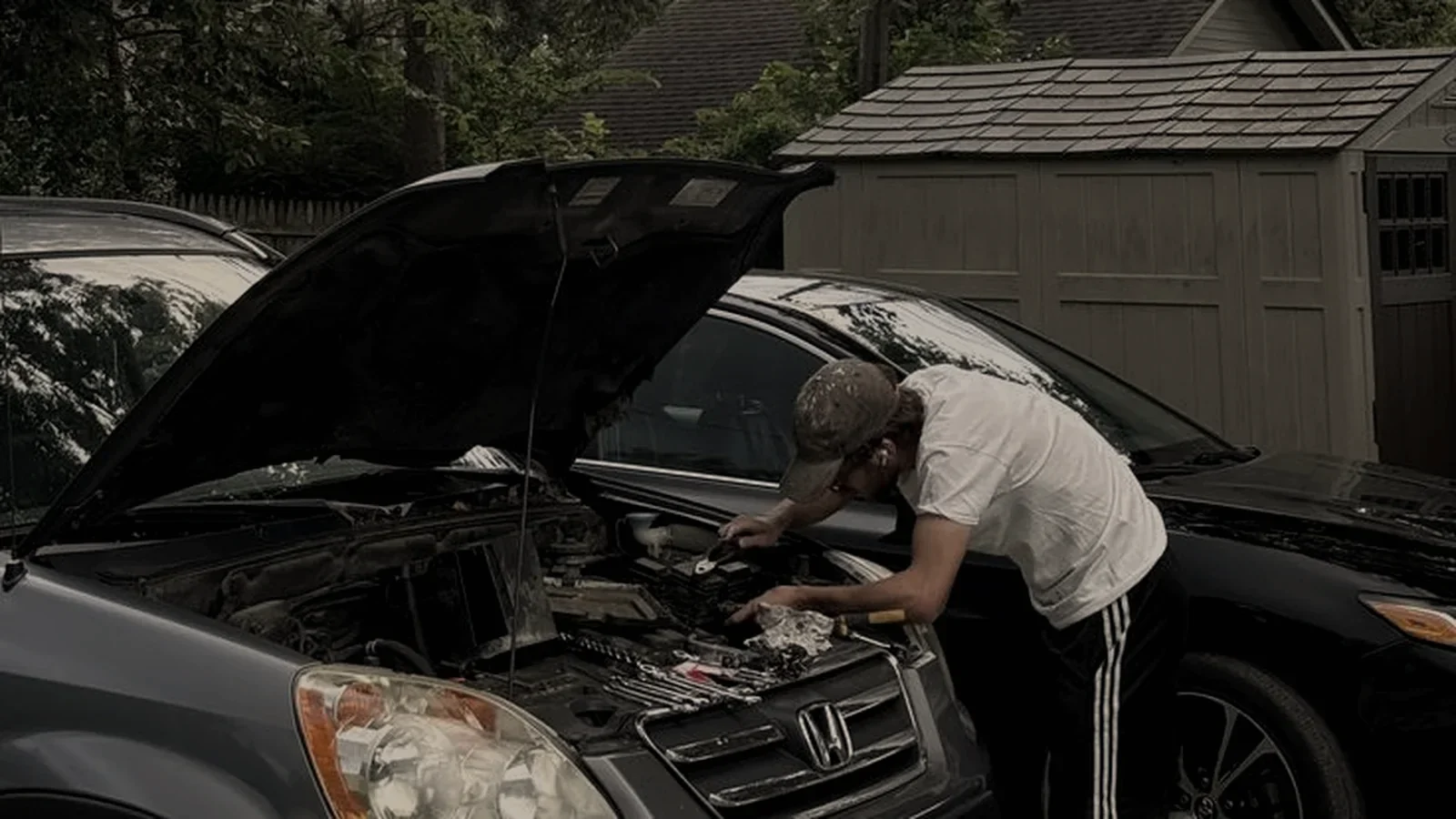
You can safely handle many basic car maintenance jobs yourself, including replacing wiper blades and some bulbs, checking tyres and fluid levels, fitting filters and changing a key-fob battery. Oil changes, spark plugs, 12-volt batteries and wheel changes can also be realistic once you have the correct procedure, tools and experience.
Use a garage when a job involves safety-critical systems, stored energy, specialist calibration or a mistake that could cause serious injury or expensive damage. That normally includes internal engine and gearbox work, timing systems, brake hydraulics, airbags, air-conditioning refrigerant and hybrid or electric high-voltage systems. The exact boundary depends on the vehicle as well as your ability.
Which car repairs can you do yourself?
This is a practical starting point, not a universal permission list. A bulb that takes two minutes to replace on one car may require bumper removal on another. Always check the handbook and a reliable repair procedure for the exact model, engine and year before starting.
| Level | Typical jobs | Sensible starting point |
|---|---|---|
| Basic checks and maintenance | Wipers, tyre pressures and condition, some bulbs and fuses, fluid checks, filters and key-fob batteries | Suitable for most careful owners after checking the vehicle-specific procedure |
| DIY with tools and experience | Oil and filter changes, spark plugs, some 12-volt batteries, wheel changes and reading diagnostic trouble codes | Attempt only when you understand the complete procedure and have the correct tools, specifications and safe working area |
| Garage recommended for most owners | Brake repairs, timing belts and chains, internal engine or gearbox work, major steering or suspension work, airbags, refrigerant systems and high-voltage repairs | The risk, equipment or calibration requirement usually outweighs the saving |
Basic car maintenance most owners can do
Wiper blades
Most wiper blades use a hook, clip or model-specific adaptor and can be changed without specialist tools. Buy the correct length and fitting, protect the windscreen with a folded towel and do not let the bare metal arm spring back onto the glass.
If new blades still smear, clean the windscreen and inspect the wiper arm before assuming the replacement is faulty.
Tyre pressures and condition
Check pressures when the tyres are cold and use the figures specified by the vehicle manufacturer for the load, not the maximum pressure moulded into the tyre sidewall. The correct values are usually in the handbook, fuel flap or door opening.
Look for cuts, bulges, exposed cords, embedded objects and uneven wear. For most UK cars and light vans, the legal minimum tread depth is 1.6 mm across the central three-quarters of the tread and around its entire circumference. A current MOT does not remove the driver's responsibility to keep the car roadworthy between tests.
Fluid levels
Engine oil, coolant and screenwash can normally be checked at home. Follow the handbook because the correct method may require a cold engine, level ground, a waiting period after switching off or an electronic oil-level display.
Use the exact fluid specification. Similar-looking coolants, oils and brake fluids are not automatically compatible. Never remove a coolant cap while the system is hot and pressurised. A falling brake-fluid level needs investigation; repeatedly topping it up can hide pad wear or a leak.
Engine and cabin filters
Many engine air filters sit in a clipped or screwed airbox. Make sure the replacement is seated correctly and that no dirt falls into the clean side of the intake. Cabin or pollen filters may sit behind the glovebox, below the dashboard or under the scuttle panel. Follow any airflow arrow on the filter.
Bulbs and fuses
Traditional halogen, indicator, brake and number-plate bulbs are often straightforward, although access varies greatly. Fit the specified type and avoid touching the glass of a halogen bulb with bare fingers.
LED and high-intensity discharge units may contain control modules, high starting voltages or sealed lamp assemblies. These are not equivalent to changing a conventional bulb.
For a fuse, switch off the affected circuit and fit the same type and current rating. If it blows again, stop. Never fit a higher-rated fuse to conceal an electrical fault.
Key-fob batteries and small trim items
A key-fob battery, damaged trim clip, bonnet or boot gas strut and some weather seals are often simple replacements. Use the correct battery or part, note its orientation and avoid forcing clips or housings that may conceal a fastener.
Jobs you can learn with the right tools
Changing engine oil and the filter
An oil change needs more than the correct grade. Confirm the required quantity, filter, drain-plug procedure, torque setting and any replacement seal or single-use fastener. The car must be safely supported if access underneath is required.
After filling, follow the manufacturer's level-check procedure and inspect for leaks. Both underfilling and overfilling can cause damage. Collect used oil and the filter in suitable containers and check your local council's rules before taking them to a household recycling centre; never pour automotive fluids into a drain or onto the ground.
Replacing spark plugs
Spark plugs may be accessible on a simple petrol engine, but dirt around the plug wells, seized threads, cross-threading and incorrect tightening can turn a service job into a cylinder-head repair. Use the specified plug and follow the vehicle or plug manufacturer's installation instructions. Do not assume one generic torque value applies to every thread, seat and cylinder-head material.
Replacing a 12-volt battery
A conventional 12-volt battery can be heavy and can release a very high current if a tool bridges the terminals. Modern cars may also require a particular AGM or EFB battery, a defined disconnection sequence, retained power for certain systems or battery registration after fitting.
Check the exact procedure before disconnecting anything. A hybrid or electric car may still have a serviceable 12-volt battery, but that does not make its separate traction battery or orange high-voltage cabling a DIY system.
Changing a wheel
Only change a wheel where you can do so without putting yourself or other road users at risk. Otherwise, call a breakdown service. Use firm, level ground, secure the car against movement, use the specified jacking point and tighten the fixings to the manufacturer's torque.
The emergency jack is for a wheel change, not for working beneath the car. Never put any part of your body underneath a vehicle supported only by a jack.
Reading fault codes
An on-board diagnostics (OBD) scanner can retrieve useful diagnostic trouble codes, but a code identifies a detected condition, not necessarily the failed part. An oxygen-sensor code, for example, may be caused by wiring, an air leak, incorrect fuelling or a sensor fault.
Record the code and freeze-frame data before clearing anything. Treat the result as the start of diagnosis, not a shopping list for replacement parts.
Brake pads and discs
Experienced home mechanics can replace pads and discs on some cars, but brakes are not a beginner's job. Electronic parking brakes, service modes, one-use fasteners, directional parts, wear sensors and model-specific bedding procedures add complexity. A mistake may not become obvious until braking is needed.
For most owners, brake work belongs in the garage column. Brake pipes, hydraulic leaks, master cylinders, anti-lock braking system (ABS) units and bleeding faults need an even higher level of caution.
Repairs best left to a garage
Timing belts, timing chains and internal engine work
Replacing a timing component may require locking tools, exact tensioning and model-specific timing procedures. On an interference engine, incorrect timing can allow pistons and valves to collide. Cylinder heads, bearings, pistons and crankshafts also require accurate measurement, clean assembly and specialist equipment.
If you are trying to understand the difference before discussing a repair, see our guide to timing chains and timing belts.
Gearboxes, clutches and major driveline repairs
Manual gearboxes, automatic transmissions, dual-clutch units and transfer cases contain precisely assembled parts and may require fluid-temperature procedures, adaptation or calibration. Clutch replacement usually involves supporting and removing a heavy gearbox. These are poor driveway jobs for anyone without suitable lifting equipment and experience.
Steering, springs and major suspension work
Some suspension parts are replaceable with ordinary tools, but coil springs store substantial energy and steering or suspension mistakes can affect control of the car. Alignment may be required after parts are changed. If the car pulls, vibrates or wears tyres unevenly, first understand the difference between wheel balancing and wheel alignment.
Airbags and restraint systems
Airbags and seat-belt pretensioners use pyrotechnic devices. Incorrect probing, handling or installation can cause deployment or leave a safety system unable to work when needed. Warning lights for airbags, ABS or electronic stability control should be diagnosed with suitable equipment and repair information.
Air-conditioning refrigerant work
Replacing a cabin filter is ordinary maintenance. Opening the pressurised refrigerant circuit is not. In the UK, recovering fluorinated refrigerant from mobile air-conditioning systems in passenger cars and light goods vehicles requires an appropriate qualification. Correct equipment is also needed to recover, leak-test, evacuate and recharge the system.
Hybrid and electric high-voltage systems
High-voltage components can retain dangerous energy after the vehicle is switched off. The Health and Safety Executive identifies fatal electric shock, fire, stored energy, harmful battery contents and unexpected movement among the risks.
Routine jobs away from the high-voltage system may still be possible, but precautions vary by manufacturer and vehicle. Do not touch, disconnect or probe orange cables, the traction battery, inverter or electric drive components unless you are trained and equipped for that exact work.
Advanced driver-assistance systems
Cameras and radar support functions such as lane assistance, adaptive cruise control and automatic emergency braking. Work involving a windscreen, bumper, sensor mounting point, wheel alignment or suspension can require calibration. Replacing the physical part does not always complete the repair.
How to decide whether a repair is safe to DIY
Before buying parts, ask these five questions:
- Do I know the fault, or am I guessing? A warning light or code rarely proves which component has failed.
- Do I have the procedure for this exact vehicle? A generic video may omit a service mode, single-use bolt or model-year difference.
- Do I have the right tools and specifications? This includes lifting equipment, a suitable torque wrench and the correct fluid or part standard.
- Can I work safely and still finish the job? Consider the ground, weather, lighting, waste, seized fasteners and whether the car can remain off the road.
- What happens if I get it wrong? A broken trim clip is inconvenient. Failed brakes, a falling car, engine damage or an electric shock are different categories of risk.
If any answer is unclear, stop before dismantling the car. Paying for diagnosis can be cheaper than replacing guessed parts or recovering an immobile vehicle.
Safety rules for working on a car at home
- Work on firm, level ground and secure the vehicle against movement.
- Use only the manufacturer's lifting points and equipment with adequate capacity.
- Support a raised car correctly with suitable stands; never rely on a jack alone.
- Keep hands, clothing and tools away from moving belts, fans and hot components.
- Allow the engine, exhaust and cooling system to cool before working nearby.
- Keep sparks, flames and smoking materials away from fuel and batteries.
- Wear eye protection and suitable gloves, and clean spills promptly.
- Do not run a combustion engine in a closed garage; exhaust gases can be fatal.
- Keep remote keys away from hybrids and EVs so the vehicle cannot become active unexpectedly.
- Record parts and fastener positions, keep removed fixings organised and recheck the completed work before driving.
If the vehicle is still under a manufacturer, aftermarket or lease agreement, also check its servicing and repair terms. Keep invoices, part specifications and a record of the date and mileage for any work you do yourself.
Conclusion
Start with low-risk jobs that let you learn the car without compromising a safety system: wipers, filters, tyres, fluid checks, conventional bulbs and simple trim. Move on only when you have reliable vehicle-specific instructions, the right tools and a safe place to work.
Use a garage when the diagnosis is uncertain or the job involves brakes, steering, stored spring energy, timing, refrigerant, airbags, calibration or high voltage. The best DIY decision is sometimes recognising the point at which the risk becomes greater than the saving.
Frequently asked questions
Can I legally service my own car in the UK?
There is no general rule requiring routine maintenance on your own car to be done by a garage. You remain responsible for keeping the vehicle roadworthy. Check warranty, finance or lease terms, follow the manufacturer's schedule and specifications, and keep dated records and parts receipts.
Does a current MOT mean my car is safe?
No. An MOT checks specified items at the time of the test. GOV.UK states that a vehicle can still be unsafe even with a current MOT certificate, so the driver must continue to check tyres, lights, fluids and any developing fault.
Can I work underneath a car using its emergency jack?
No. Never work underneath a vehicle supported only by a jack. Use the correct lifting points, suitable rated support equipment, firm level ground and wheel chocks. If you do not know how to support the car safely, leave the job to a properly equipped garage.
Should I replace a part because an OBD code names it?
Not without further checks. A diagnostic trouble code describes a condition detected by a control unit. Wiring, air leaks, voltage problems or another component may be responsible. Record the evidence and test the circuit or system before replacing parts.
What should I do if a DIY repair becomes more complicated than expected?
Stop before forcing or bypassing anything. Make the vehicle safe, photograph its current state, keep removed parts and fixings organised, and explain exactly what has been done when arranging professional help. Do not drive if the work affects braking, steering, fluid retention or another safety-critical system.
Need help with a warning or fault code?
If a warning keeps returning, start with a diagnosis. Contact BSG Automotive with your vehicle details, symptoms and any fault codes so we can discuss the next checks. Do not clear the codes repeatedly before recording them, as stored information may help identify the cause.
You might also like
Sources and further reading
- GOV.UK: Check your vehicle is safe to drive — roadworthiness, routine checks and UK tyre tread requirements.
- The Highway Code, Annex 6: Vehicle maintenance, safety and security — tyre condition and safe roadside wheel changing.
- HSE: Working under vehicles — jacking points, stands, chocks and safe support.
- HSE: Electric and hybrid vehicles — high-voltage hazards and vehicle-specific precautions.
- GOV.UK: Qualifications to work with F gas — qualification requirements for mobile air-conditioning refrigerant recovery.